Sundiata
Sunjata Keita
not scary at all
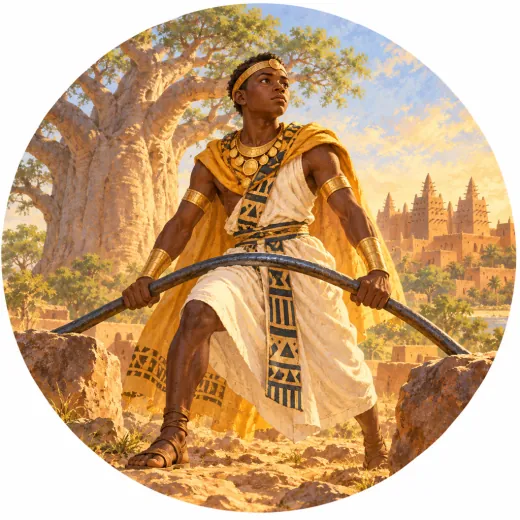
Sundiata is the founder of the Mali Empire, who lived in the thirteenth century, and his story mixes history and legend. As a child he could not walk and everyone mocked him, above all the queen who was his mother's rival. One day, to defend his mother's honour, he asked for an iron bar, leaned on it and, with a huge effort, stood up, bending the iron. Then he pulled up a whole baobab tree and carried it home. As a man he defeated the sorcerer king Soumaoro and founded an empire.
Did you know? His story has been handed down for centuries by griots, storytellers and musicians who know the history of families and kings by heart.
The story
Listen. I am a griot, son of griots, and my people have kept the memory of kings for so long that nobody remembers any more who began the remembering. What I am about to tell you has not changed in seven hundred years. So listen.
There was a king in the land of the Mandinka, Naré Maghan, and one day a hunter came to his court with a prophecy. He said the king would marry an ugly woman, a woman with a hunched back, named Sogolon, the buffalo woman. And that she would give birth to a son who would make Mali greater than any other land.
The king asked no questions. He married Sogolon.
The child was born, and they called him Mari Djata, the lion prince. But the lion did not stand up. Months went by, then years: one year, three, five. The boy ate enough for ten, his eyes were bright, but he stayed on the ground, and they had to carry him in their arms like a baby.
All around him, voices laughed. One voice above all: that of Sassouma Bérété, the king’s first wife, who already had a son, Dankaran Touman, and who spent her days reminding Sogolon that her son was good for nothing.
When the king died, Sundiata was seven years old, and he still could not walk. Sassouma had her Dankaran crowned. Sundiata was left with only one companion: Balla Fasséké, son of his father’s griot, who would stay by his side all his life.
One day Sogolon went to Sassouma to ask for a few baobab leaves, which she needed for cooking. Sassouma gave them to her, with a crooked smile. “Here are your leaves. But tell me: is your son the king walking yet?”
Sogolon came home with tears in her eyes and the leaves in her hand.
Sundiata was sitting on the floor in the dim room. He looked at his mother. He understood everything, and for a long time he said nothing.
Then he said: “Mother, don’t cry. Go to the blacksmith and ask him for an iron bar. The heaviest one there is.”
The blacksmiths forged it. It was a long black bar that two men could barely lift. They planted it in the ground in front of the door and held it steady. Sogolon began to sing. Balla Fasséké began to sing. And all the people gathered in front of the house stopped breathing.
Sundiata gripped the bar with both hands. He pressed his palms against the cold metal, stretched out his arms, and pulled.
The bar bent.
It seemed as if the earth itself were holding its breath. The boy’s legs trembled, thin as reeds, but his body was rising. An inch. A hand’s breadth. He rose all the way up. For the first time in his life, Sundiata was standing.
“Mother,” he said, the words coming out with difficulty, “you asked for baobab leaves. Now I will bring them to you.”
He walked. He went to the biggest baobab in the village, the tree with a trunk as wide as a hut, and he put his arms round it, and shook it the way you shake a child. The roots tore out of the earth with a crack. Sundiata heaved it onto his shoulders and carried it home, to his mother’s door, and set it down like a bundle of firewood.
“Here are the leaves, Mother. Take as many as you like.”
From that day on, everyone knew who he was. Sassouma included. And Sassouma, who was afraid, began to think about how to get rid of him.
Sundiata had to leave. With his mother, with his brothers and sisters, with Balla Fasséké, he walked from kingdom to kingdom, in exile. He learned to fight, to hunt, to listen. Wherever he went, people saw something in his eyes that was calm and tired at the same time, like someone who has waited a long time. In Mema, King Moussa Tounkara welcomed him like a son and gave him command of part of his army.
Meanwhile, in the north, another king had grown powerful. His name was Soumaoro Kanté, and he was lord of the Sosso. He was a blacksmith and a sorcerer. He wore amulets and could do things no man can do: he vanished, reappeared, spoke with the dead. He had conquered the neighbouring kingdoms one after another, and in the end he had reached Mali too. Dankaran had fled. The villages were burning. People did not dare speak Soumaoro’s name, not even in a whisper.
That was when the messengers from Mali came to Mema and knelt before Sundiata.
“Come back,” they said. “You are the only one.”
Sundiata stood up. He was no longer the child carried in people’s arms. He was a tall, silent man, with shoulders as broad as a doorway. He gathered an army of horsemen, archers and hunters, and marched north.
They met at Krina. It was an open plain with short grass, and when the sun rose the two armies looked at each other from afar. From the Sosso side rose the drums, a dull rumble like a storm. On the Mali side, Balla Fasséké was playing the balafon.
Soumaoro advanced first, wrapped in a cloud of dust. His sorcerers chanted. The horses panicked. Arrows that hit him seemed to bounce off.
But Sundiata knew something Soumaoro did not want anyone to know. Soumaoro had only one weakness: the spur of a white rooster. Every other weapon slid off him; that one alone could wound him. Sundiata fitted an arrow tipped with that spur, took aim in the din, and let it fly.
The arrow barely grazed the sorcerer king’s shoulder.
It was enough. Soumaoro let out a cry, and his strength drained away like water into sand. He left the field, withdrew into the mountains, and no one ever saw him again.
The sun was high when Mali understood that it had won.
The chiefs came from every direction, one after another, to kneel before the young man who had once been a child on the ground. They proclaimed him mansa, emperor. Mali, which had been a small kingdom, became an empire as big as a world.
And I, Mamadou Kouyaté, son of griots, tell you that this is not a children’s tale. It is the memory of a people. Because there was a time when nobody believed that boy would ever stand up. And then he stood.
A living tradition, told with respect: how we tell myths.
Relatives around the world
Listen / Read next
- Music to read by: Cinematic JourneyEpic film-style music, no lyrics, by Ciro Simone IrmiciSpotifyYouTube Music
Sources
- Djibril Tamsir Niane, Soundjata ou l'épopée mandingue (1960), from the telling of the griot Mamadou Kouyaté
