Sa Musca Macedda
“the macedda fly”, in Sardinian
scary
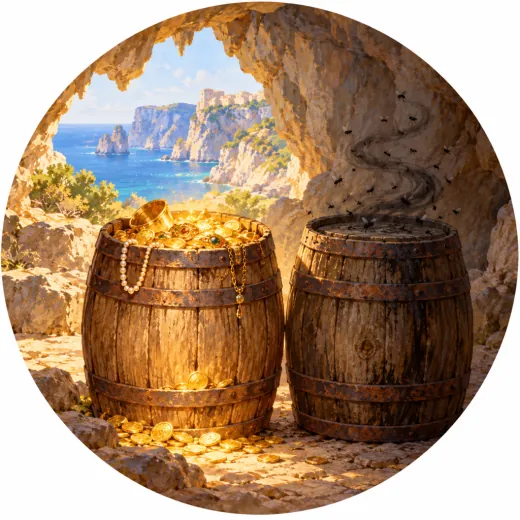
In many villages of Sardinia people said that two identical barrels were hidden underground. One was full of gold and jewels; the other was full of musche maceddas, giant flies as big as a sheep, with a terrible buzz. Whoever found the barrels had to choose without knowing which one was right: open the wrong barrel, and the swarms would invade the world. So nobody dared to dig. Scholars think the flies were the face of the epidemics that struck the island.
Did you know? The linguist Gino Bottiglioni collected the most complete versions of this legend in 1922, and almost every village put the treasure in a different place.
The story
In Sardinia there are places where nobody digs.
Not because the ground is hard. Not because of any lack of will. It is said that under certain fields, certain churches, certain stones, a treasure lies buried, and that nobody has ever dared to look for it.
The reason is in the two barrels.
There are two, identical. The same wood, the same iron hoops, the same dust. One is full of gold and jewels, of all the wealth a man can imagine. The other is full of flies.
Not flies like the ones that wander round the kitchen in summer. They are called musche maceddas. They look like a fly, only they are as big as a sheep. They have wings as strong as sails, and an enormous sting, which does not forgive.
And whoever finds the barrels cannot know which is which.
If he opens the right one, he becomes rich. If he opens the wrong one, he dies, and with him, the old people say, the world ends.
They tell of a farm labourer who tried, or at least thought about it.
He was a day labourer and owned no land. Every morning he went to work in a field not his own and every evening he came home with cracked hands and a piece of bread. His wife was tired. His children had no shoes.
One evening, at supper, an old man of the village said to him, almost without looking at him: "Do you know what is under the old wall, behind the church?"
"What?"
"Nothing," said the old man. "But it is better not to dig."
From that moment the labourer thought of nothing else. He spoke of it only once, to his wife, in a low voice, while the children slept.
"If it's the right barrel," he said, "we won't have to work any more."
"And if it's the wrong one?" she asked.
He did not answer. That question followed him all day, in the fields, behind the plough, under the sun beating on his back.
For days he passed in front of that wall, and looked at it as one looks at a closed door. Then, one evening at the end of summer, when the village slept and only the crickets spoke, he took a spade and a lantern and left the house without waking anyone.
The air was still. The wall was cold even in the warmth of the night.
He set the spade against the ground. And he heard it.
A sound, small, very distant. A buzzing. It was not like that of bees, which is sweet. It was low, continuous, as if something enormous were breathing under the earth and trying, with its wings, to open a way out.
The labourer stood motionless. His heart pounded in his ears.
Perhaps it is the wind, he thought. Perhaps it is the roots.
But the buzzing did not stop. It changed, in fact. It grew louder when he moved, weaker when he stood still, as if something down there were listening.
And at that moment, in the dark, he seemed to understand what was really at stake. Not his spade, not his wealth. In one barrel were shoes for his children. In the other were his children, and the whole village, and the field where he worked, and the church, and the whole island. And there was only one chance in two.
He put down the spade, very slowly, as if it were made of glass. The buzzing now seemed closer. He did not turn round. He walked backwards to the corner of the church, and only then, breathless, began to run.
He reached home. He shut the door, leaned his back against the wood and felt the cold sweat run down his neck.
"Where have you been?" his wife asked from the bed.
"Nowhere," he said.
The next morning he went to see the priest, and did not tell him why. He only said he had had a bad dream. The priest looked at him for a long time.
"You know," he said, "it is said that in certain villages only the priest knows how to keep the fly away. Because the spirit is stronger than fear. You did well not to dig."
That day the labourer worked as usual, but every time he passed the wall he changed his route. The other labourers watched him without asking anything: in certain villages, certain things are not asked.
The labourer never dug again. And he never told anyone what he had heard.
But now and then, at night, when the wind dropped, he seemed to hear it still: a distant buzzing, under the wall, patient.
This legend does not belong to a single village. Many people told it, and each put the treasure in a different place: at Alghero, at Esterzili, at Sorgono, under a church at Valenza. The fly, besides, has several names: it is also called musca manchèdda, the fly of the left hand, because the right hand is God's and the left is the devil's.
At Nuchis, they said, a fly really did come out. As big as an ox's head, with a terrible sting. It destroyed much around it, until it died.
The linguist Gino Bottiglioni collected the most complete versions in 1922. Today, according to one of the most credible hypotheses, those flies are the face of a real nightmare, the epidemics that struck the island several times. The plague above all: it was believed, in fact, that flies were what carried it.
Who knows what is really under those walls. Perhaps nothing. But nobody, so far, has wanted to put it to the test.
That, perhaps, is why nobody has ever dared to dig.
Listen / Read next
- Music to read by: Cinematic JourneyEpic film-style music, no lyrics, by Ciro Simone IrmiciSpotifyYouTube Music
- The words of the dialect: SardinianNonnese, the dictionary of Italian dialects
Sources
- Gino Bottiglioni, «Leggende e tradizioni di Sardegna» (1922)
- Pantaleoni e Bagella, studio sulla Musca macedda, Università di Sassari (2021)
