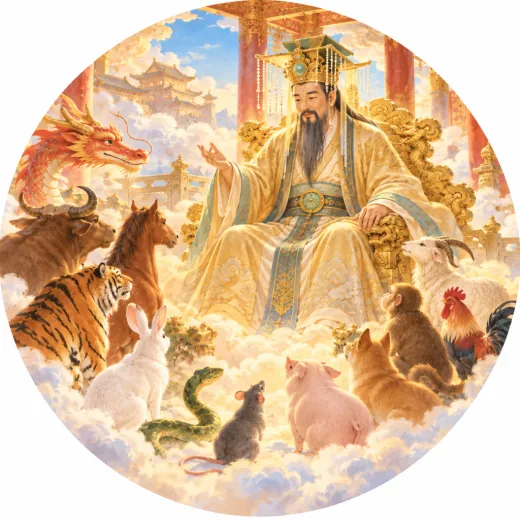
The Jade Emperor
玉皇大帝, in Chinese
not scary at all
In Chinese folk religion and in Taoism, the Jade Emperor is the ruler of heaven. His court works like an emperor's court on earth, with ministers, generals and heavenly officials who keep records of everything. The novel Journey to the West tells of it too: the Monkey King, Sun Wukong, is welcomed into the heavenly court and put in charge of the stables, but he rebels and wins the title of “Great Sage Equal to Heaven”. The Emperor sends the heavenly army against him, and the rebellion ends only with a bet lost before the Buddha.
Did you know? in Journey to the West the Monkey King eats the peaches of the Queen Mother's garden and steals Laozi's pills, before he is stopped.
The story
In the jade palace, at the top of the sky, every day begins with a register.
There are thousands: great books bound in silk, each one kept by an official with long sleeves and a brush tucked behind his ear. One records how many drops of rain must fall on every valley. Another, how many years each person has lived and how many are left. Every morning the Lord of Thunder, the God of the Winds and the other ministers bow before the throne and report, and the Jade Emperor listens, almost always without speaking.
Ruling heaven, for him, was a matter of patience.
That is why it took him a while to notice the Monkey King.
He came from a mountain on earth, where he had been born from a stone and learned from a master how not to die and how to fly on clouds. His name was Sun Wukong. He respected no one: he had seized an iron staff that grew longer or shorter at will, and threatened anyone within reach.
“Majesty, there is a problem. On earth.”
“What problem?”
“A monkey.”
The Emperor did not get upset. He listened, and it was the Star of Venus, an old white-haired minister, who suggested a solution. “If we invite him to heaven and give him a post, he will obey us. If we leave him on earth, he will go on causing trouble.”
So the Monkey King rose to heaven and was welcomed with every honour. His position: keeper of the heavenly stables. He looked after the horses, fed them, washed them, combed them. He did it for half a month, delighted, until he asked a colleague:
“What rank is this, mine?”
“It isn't a rank,” the colleague answered, embarrassed. “It's a job. The smallest one there is.”
The Monkey threw down his comb and went back to his mountain, shouting to everyone that he now called himself “Great Sage Equal to Heaven”.
At that, the Emperor sent the army. Its commander, a heavenly king who always carried a golden pagoda in his hand, came back with a long face: his soldiers had been beaten, one after another, by a single monkey with a staff.
“What do you propose?” asked the Emperor.
The Star of Venus bowed. “Give him the title he asks for. It is only a title, with no power. But it will keep him quiet.”
And so that he would not sit idle, they put him in charge of the peach garden.
The Emperor agreed. And for a while heaven breathed again.
Then came the banquet.
Every year the Queen Mother of the West gave a feast where the peaches of immortality were served, peaches that ripened once every few thousand years. The Great Sage, keeper of that very garden, had been tasting them among the branches: one peach, then another, then every one he could find. And he had not been invited. When he found out, he drank the wine laid out for the banquet. Then, passing the house of Laozi, the old sage, he went in and swallowed the pills of immortality that Laozi had spent years and years preparing.
By the time the ministers discovered the disaster, the Monkey King had fled, drunk on wine and more immortal than anyone could stand.
This time the Jade Emperor did not wait. He sent a hundred thousand heavenly soldiers, with banners and drums. The fighting lasted one day, then two. The Monkey King turned into a bird, a fish, a temple, anything, and every time he was recognised. In the end he was caught by Erlang Shen, a warrior with a third eye in the middle of his forehead that could see through every disguise, together with a heavenly hound.
They brought him before the Emperor, bound.
“Execute him,” said the ministers.
They tried, in vain: axes snapped, fire did not burn him, lightning tickled him. Thanks to the peaches and the pills he had swallowed, he had become almost impossible to kill. So Laozi made an offer. “Give him to me. I will put him in my furnace and cook him until the pills melt away.”
For forty-nine days the fire blazed under the furnace. When Laozi opened it, the Monkey King leapt out livelier than ever, his eyes shining like gold. The smoke had only changed his sight. He seized his staff and stormed into the palace, and nobody could stop him. He overturned tables, smashed pillars, sent ministers and generals running.
The Jade Emperor, seated on his throne, did not get up. He did not shout. For the first time in many centuries he looked around, and saw the hall empty.
“Send for the Buddha,” he said.
The Buddha arrived, calm, and stopped in front of the Monkey King, who pointed his staff at him.
“And what can you do, to claim the throne of heaven?”
“I know seventy-two transformations,” said the Monkey. “And with one somersault I cover a hundred and eight thousand li.”
“Then let us make a wager,” said the Buddha. He opened his hand. “If you can jump out of my palm, the throne is yours. If you cannot, you go back to earth and stop causing trouble.”
The Monkey King laughed. He leapt. He flew for a very long time, until at the end of space he saw five great pink pillars, and thought they were the edge of the world. Just in case, he wrote his name on one of them, and for a laugh he left a wet mark there too. Then he came back.
“I've won,” he said. “I've been to the end of the sky.”
“Look more closely,” said the Buddha.
On the middle finger of the open hand, in his own handwriting, was the Monkey King's name. And at the foot of the finger, the wet mark of his joke.
He had no time to escape. The hand closed, became a mountain, and the Monkey King stayed underneath it for five hundred years.
In heaven there was a great feast, to thank the Buddha. The Jade Emperor ordered the finest banquet anyone could remember. From his seat he watched the officials return one by one, registers under their arms, sleeves a little crumpled.
That evening, when everything was in order, he wanted to check. He opened the register and looked for the monkey's name. His page was gone. Only, at the bottom of a column, someone had added a single line in fresh ink: five hundred years.
The Jade Emperor read it, and for an instant it seemed to him that he was almost smiling. Then he closed the book, because tomorrow another day would begin.
A living tradition, told with respect: how we tell myths.
Relatives around the world
Listen / Read next
- Music to read by: Cinematic JourneyEpic film-style music, no lyrics, by Ciro Simone IrmiciSpotifyYouTube Music
Sources
- Wu Cheng'en, Journey to the West (16th century)
- Lihui Yang and Deming An, Handbook of Chinese Mythology, ABC-CLIO (2005)
