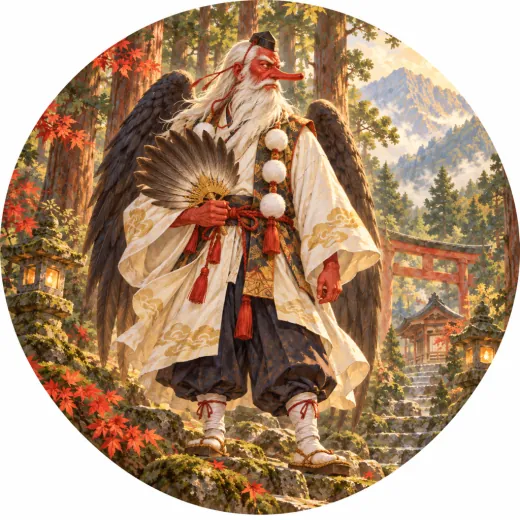
Tengu
天狗, “heavenly dog”
a little scary
Tengu are spirits of the mountains and forests. The oldest ones had the beak and wings of a bird; the most famous ones today have red faces and very long noses, and dress like mountain monks. They are proud and a little mischievous towards people who show off, but they are also excellent teachers of swordsmanship and martial arts. A famous legend, born later in the Nō theatre, tells that the young warrior Minamoto no Yoshitsune learned to fight from a tengu king on Mount Kurama.
Did you know? In Japan, people say that a very vain person “has become a tengu”.
The story
By day the boy studied prayers with all the others. By night he did not sleep.
He lived in a temple on Mount Kurama, where the cedars were so tall that at noon it was already evening in the woods. He was twelve years old, or not quite, and he had a childhood name: Ushiwakamaru. His father had been a great warrior, the head of a clan, and his enemies had defeated and killed him. To save the boy, his mother had sent him up there to become a monk. Monks, at least, were not hunted by their enemies.
But he did not want to become a monk. He wanted to learn to fight.
So, when the temple was asleep, the boy would get up quietly, take a wooden sword he had hidden under the mats, and slip out through the back door. He went down the path, between the roots, to a clearing deep in the woods. There he practised alone, for hours, against a tree. He struck, he parried, he stepped back. The tree never answered.
One night, someone did.
“Strike with your whole arm. A child who fights a tree trunk will never beat a warrior.”
The boy spun round.
On a low branch, a step away from him, sat a man. Or something that looked like a man. His face was as red as a sunset, and he had a very long nose that stuck out in front of him like a second arm. He wore the robes of a mountain monk, and on his feet were wooden clogs as tall as stools, on which he balanced as if it were nothing at all. In his hand he held a fan of feathers.
Behind him, in the shadows, there were other creatures, smaller ones, dark as crows. They had beaks and wings. They moved without a sound. The boy knew at once what he was looking at.
Tengu.
In the old books the monks kept in the temple, tengu were kites, bird-demons who disguised themselves as monks, and they often played nasty tricks on proud monks and priests: they pretended to be saints, they pretended to be teachers, and then they vanished, laughing. The boy had always thought these were stories to frighten the novices.
“Are you afraid?” asked the king of the tengu.
“Yes,” said the boy. It was true. “But I want to learn.”
The king of the tengu tilted his head. Something glinted in his eyes.
“You are the first one to admit it. Usually they tell me they are already good enough.”
He hopped lightly down from the branch and planted himself in front of the boy.
“Let's have a test. Hit me.”
The boy raised his wooden sword and struck. The feather fan moved just once, barely, and the sword flew away. He struck again. He landed on his bottom. He struck a third time. He ended up with his face in the dirt.
He got up. His elbows were grazed and his ears were burning.
“Again,” he said.
That night he learnt nothing, except that he knew nothing. The next night he came back. And the night after that.
Every dawn found him on the path back, covered in earth, with leaves in his hair. The monk who woke him for prayers looked at the bruises and asked no questions. Perhaps he knew. Perhaps, in a temple on Mount Kurama, some questions are better left unasked.
The king of the tengu taught him not to watch his opponent's blade, but his shoulders. He taught him to leap from branch to branch as if he had wings, to walk without making the leaves crackle, to stand still as a stone when there were seven attackers trying to surprise him from every side. He taught him that a sword is not a stick longer than your arm, but a way of thinking. The lesser tengu, the ones with beaks, circled round him and shoved him, and knocked him over, and laughed.
Months went by. Then years. In winter the snow covered the clearing, and the boy practised anyway, his hands cracked by the cold and his breath steaming, while the lesser tengu dropped from the trees without leaving a single print in the fresh snow. The boy grew, and his shoulders broadened. One evening, in the clearing, he finally managed to brush the feather fan with the tip of his wooden sword.
He was stunned. Then he shouted: “I did it! I did it! Nobody has ever managed to touch you!”
And straight away he noticed that the woods had gone silent.
The lesser tengu had gone. The king of the tengu stood still beside the tree, arms folded. He was not laughing.
“You have become good,” he said quietly. “Now listen to something. I am a tengu, and I know everything about pride. It is the thing we know best, because it is exactly what changed us. Anyone who shows off and thinks he is already a master has stopped learning. And someone like that, up in the mountains, ends up becoming one of us.”
The boy's mouth fell open. Then, slowly, he lowered his sword. He lowered his head too. He bowed until his forehead almost touched the leaves.
“I was wrong,” he said. “I still have so much to learn.”
For a while there was no answer.
Then, high above, came a whirr of wings. The king of the tengu burst out laughing, a long laugh that made the branches shake.
“There. Now you have it. One more time.”
And they started again.
The years went by, the way they do in the mountains: with nobody counting them. One day the boy left the temple, because he had other men and other battles to meet, and his name became famous throughout the land as that of Minamoto no Yoshitsune, the warrior who defeated his family's enemies. Hardly anyone knew who had trained him. When people asked, he smiled and did not answer.
But the monks of Mount Kurama say that, on windy nights when the cedars creak like sails, a long dark feather is sometimes still found in the clearing deep in the woods, resting on a wooden sword.
Nobody picks it up.
And if one day someone passing that way were to boast too loudly, the old people say there is no need to worry.
The tengu has already heard.
A living tradition, told with respect: how we tell myths.
Relatives around the world
Listen / Read next
- Music to read by: Cinematic JourneyEpic film-style music, no lyrics, by Ciro Simone IrmiciSpotifyYouTube Music
Sources
- Konjaku Monogatari Shū (12th century)
- Gikeiki, The Chronicle of Yoshitsune (14th century)
- Nō play Kurama Tengu (Muromachi period)
