The Legend of Lago di Misurina
Lake Misurina: Princess Misurina and King Sorapiss
a little scary
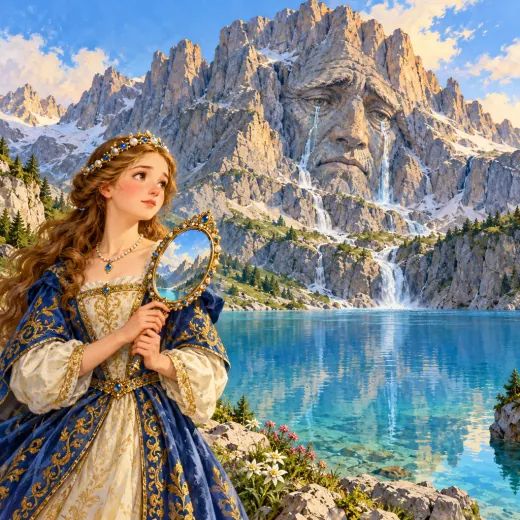
King Sorapiss had only one daughter, Misurina, who was very spoilt. One day she heard that a fairy of Mount Cristallo owned a magic mirror able to read thoughts, and she wanted it at any cost. The fairy agreed to give it on one condition: the king had to turn into a mountain. Out of love for his daughter, Sorapiss accepted. But while her father was turning to rock, Misurina, happy at the thought of playing on the new mountain, looked down, felt dizzy and fell from the summit. The mountain-king wept so much that his tears formed two streams, which joined further down: the lake was born.
Did you know? The lake bears the princess's name, and the big mountain nearby, Sorapiss, bears her father's.
The story
A very long time ago, between the Tofane, the Antelao, the Marmarole and the Tre Cime di Lavaredo, there was a kingdom. Its king was called Sorapiss, and of all his wealth he cared about one thing only: his daughter.
The daughter was called Misurina. She was the only one he had left, because her mother was no more. And the king, a widower, looked at her every morning as one looks at the light coming in through a window. For this reason he forgave her everything. And Misurina had a great deal to be forgiven.
She was pretty, it must be said. She had lively eyes and a way of laughing that made you forget everything else. But she was also capricious, spiteful, and used to getting whatever she asked for. When she did not get it, she stamped her feet, and the valleys seemed to tremble.
One day, when she was eight years old, Misurina heard talk of a fairy.
She lived on Monte Cristallo, and she had a mirror. Not just any mirror. Whoever looked into it did not see their own face, but their own thoughts: everything they had in their head, even what they told nobody.
"I want it," said Misurina.
"It is not a mirror for little girls," replied the king.
"I want it!"
"Misurina..."
"I want it, I want it, I want it!"
For days and days Misurina spoke of nothing else. She did not eat, she did not play, she did not even go down to look at the lake of mist that rose at dawn. She sat at the foot of the throne and said only: "I want it."
The king, who did not know how to say no to her, in the end gave in. He took his daughter by the hand and climbed with her up Monte Cristallo, to a garden where, among the rocks, grew flowers that were nowhere else.
"Papa, why are you so sad?" asked Misurina.
The king did not answer. He climbed higher, where the air grew thin, and along the way he stopped to look at his mountains, one after another, as one greets friends before a long journey. The wind carried a scent of resin and snow. Misurina trotted beside him, with her eyes always fixed ahead, on the spot where the fairy would appear.
The fairy received them at the edge. She was in no hurry, and did not seem glad to see them.
"I know why you are here," she said. "I will not give it to you, little one."
Misurina began to cry, to scream, to stamp her feet. The king knelt down. He prayed, he begged. And at a certain point tears came to his eyes too, big tears of a man who no longer knows what to do.
The fairy looked at him for a long time.
"Very well," she said at last. "But I ask something in exchange."
She pointed to the garden behind her. The flowers, that year, were burning. The sun beat down too hard, and without shade they would not survive.
"I need a mountain to protect them. A tall mountain, to bring its shadow over my garden. If you want the mirror for your daughter, you must become that mountain."
The king looked at Misurina. Misurina was looking at the mirror, already far away in her thoughts.
"I accept," said Sorapiss.
The fairy handed the mirror to the girl. Misurina took it in her hands and laughed with joy. And when she learned of the pact, she felt no fear, not even a little. She only thought that her father would become a mountain, a mountain all for her, on which she could run and play as much as she liked.
While she looked into the mirror, a deep noise was heard, like a distant avalanche. The king was being transformed. His body swelled and changed colour, from flesh to stone, from stone to pale rock. His hair became trees. The wrinkles of his face opened like crevasses.
Misurina climbed onto the giant's shoulder, onto his back, onto his flank, laughing, higher and higher. The wind tousled her hair. The world, from up there, was small and beautiful.
Then she looked down.
The valleys were very far away. The walls dropped straight, without a handhold. She felt her head spin, her legs no longer holding her. She stretched out a hand to cling to something, but there was nothing to grasp. The mirror slipped from her hand.
And she fell.
The king, by now almost all mountain, saw everything. He could not move, he could not cry out, he could not stretch out his arms to catch her. His eyes, the last pieces of him that were still his own, stayed open.
And from his eyes tears began to flow. Many tears. They poured without stopping down the rock, until they formed two streams, and the two streams, in the valley, joined into a single stretch of water, still, deep, immense.
It was the lake. They called it Misurina.
In the fall the mirror had gone into a thousand pieces, among the rocks. And the streams of tears carried down all those fragments, which scattered in the water. For this reason, they say, the lake has such a strange reflection: blue, green, sometimes almost silver, depending on the sky and the hour. This is one of the versions: in others Misurina falls out of remorse, or the lake is a gift from the fairy.
That mountain is still there. They call it Sorapiss, like the king. And at its foot the lake, silent, reflects the sky and the rock, and keeps, perhaps, what a little girl would have wanted to see in a mirror: the thoughts of the one who loved her more than anything else in the world.
Relatives around the world
Listen / Read next
- Music to read by: Cinematic JourneyEpic film-style music, no lyrics, by Ciro Simone IrmiciSpotifyYouTube Music
- The words of the dialect: VenetianNonnese, the dictionary of Italian dialects
Sources
- Karl Felix Wolff, «Dolomitensagen» (1913)
- SiViaggia (sito di viaggi), «La leggenda del Lago di Misurina»
