The Legend of the Lago Blu
the Blue Lake: Lac Bleu, also called Lake Layet
a little scary
Where a bright blue pond lies today, there once stood the house of a rich but stingy family of shepherds. One day a hungry traveller knocked at the door, and the mistress of the house laughed and chased him away. Only the youngest son secretly brought him a bowl of milk, and as a punishment he was sent into the woods to gather firewood. When he came back, the house was gone: the water had covered everything. Why the water is so blue is explained in different ways: a mineral on the bottom, or algae. It is one of many “punished village” stories of the Alps.
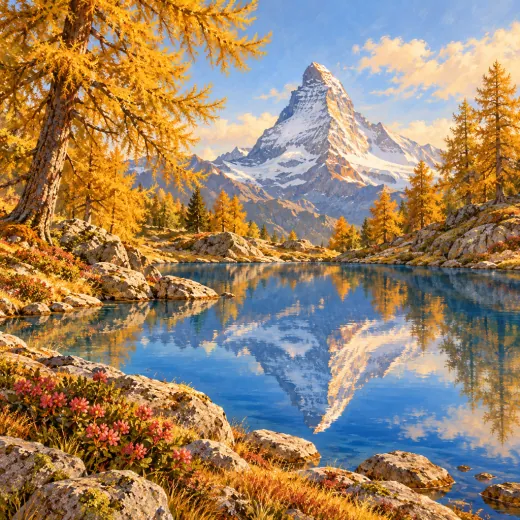
Did you know? On still days the Matterhorn is reflected in the water of the Lago Blu as in a mirror.
The story
When the wind stops, at Giomein, above Breuil, something strange happens. The lake turns into glass. The Matterhorn falls into it, whole, point downwards, and the larches make a second forest underwater.
The water is such a strong blue that it does not seem real. They call it the Lago Blu, the Blue Lake, and some call it Lake Layet. If you lean over the shore and look carefully, on the bottom you can see logs lying side by side. They look like the beams of a roof.
The old people of the place, at this point, lower their voices. Because they say that they are exactly those.
It is told that there, where the water is now, in a green valley of firs and rhododendrons, a house once stood. A family of shepherds lived there. They had sheep, milk, cheese, a full pantry. They had no pity.
One evening a wanderer arrived.
The sun was already behind the ridges and the air was growing cold, with that mountain cold that gets into your bones even in summer. The wanderer came from far away, you could tell from his clothes, torn in several places. He was pale and tired, and walked leaning on a big stick full of knots. He stopped in front of the door. He stood a moment watching the smoke coming out of the chimney. Then he knocked.
The mistress of the house opened.
"I am hungry," said the wanderer, softly. "A little is enough. A milk soup, a bit of polenta."
The woman looked him up and down. She did not answer. She turned her back on him, and behind her the fire crackled, and nobody got up.
In a corner of the kitchen was the youngest son, with his bowl of milk in front of him, the one for his breakfast. He heard the stranger's voice. He saw how thin he was. He stood up with the bowl in his hand and took two steps towards the door.
"Sit down," said his mother.
The others began to laugh. One took a bowl and filled it from the bucket where they washed the tools: grey, dirty water. They held it out to the wanderer, with a mock bow, as to a lord.
He did not take it. He looked at the bowl, then looked at those faces one by one. The boy, with his bowl motionless in his hands, lowered his eyes.
The wanderer turned. He went off along the path, his stick tapping on the stones, and as he moved away he murmured words that nobody understood. They were low and dark. The wind, which until then had been blowing, stopped all at once.
"Strange fellow," someone said. They shut the door.
Here, in one version, the story goes on like this. Not even the boy was forgiven. He had wanted to give his milk to a stranger: as a punishment, his mother sent him out, into the wood, to gather firewood. It was dark. Outside there were the sounds of the night: the rustle in the branches, an owl, something running in the undergrowth.
The boy was afraid. It seemed to him that the trees bent down to look at him, and that every dry branch had the shape of a hand. But he walked, and gathered branches, one after another, and made them into a bundle. Every now and then he stopped to listen. From far away, down the valley, came something like a footstep going away, and then nothing more. He thought of the bowl he had not carried. He thought that, if he had been a little quicker, perhaps the wanderer would still be there.
He gathered wood for many hours, enough to have his arms full. Then he went back.
The path was the same one, he knew it by heart. But at a certain point he stopped smelling the smoke. He also stopped hearing the cowbells, the dogs, the sound of the stream that ran behind the house. There was a wide, heavy silence, like the one that remains after a cry.
The house was no longer there.
Where the door had been, where the kitchen had been, where the fire had been, there was an immense lake. Still on its surface, dark, the stars. No sound. Not a voice, not a bleat. Nobody down there answered, however much the boy called.
He let the wood fall. He wept on the shore, for a long time.
When he had finished weeping, he understood. There had been no storm, no landslide. That water had come because someone had shut the door on a hungry man. He had not shut it, and that was why he had stayed there, to watch.
So it is told that he stayed to live on the shores of that lake, and that his descendants, men and women, settled beside the water. They never forgot that story. And for this reason, in those houses, when a wanderer knocked, the door opened. To the hungry they gave food, to the weary a place by the fire, without asking anything.
Even today, in summer, there are hikers who sit on the shore and look at the Matterhorn reflected. Few know why that blue is so clear. Explanations have been given: a mineral on the bottom, algae. But from the shore, if the water is still, the logs can still be seen, on the bottom, lying in a row.
If someone tells you they are only old fallen trees, do not argue. Smile, and look at the lake one last time before you leave.
Relatives around the world
Listen / Read next
- Music to read by: Cinematic JourneyEpic film-style music, no lyrics, by Ciro Simone IrmiciSpotifyYouTube Music
Sources
- Regione Autonoma Valle d'Aosta, turismo, «La leggenda del Lago Blu»
- Tersilla Gatto Chanu, «Leggende e racconti popolari della Valle d'Aosta»
