The Madonna della Bruna of Matera
the feast of 2 July
not scary at all
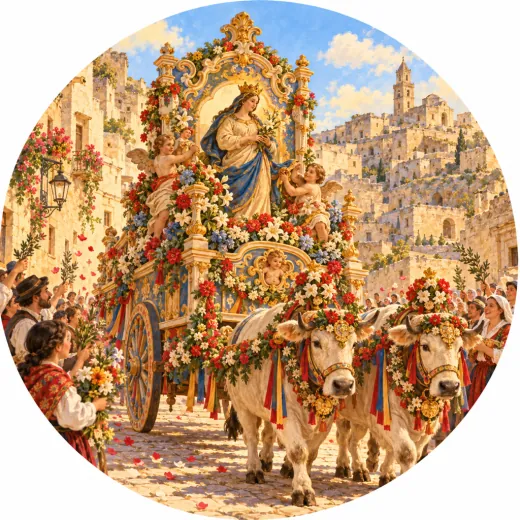
A legend from Matera says that a farmer gave an unknown girl a ride on his cart. She handed him a message for the bishop and vanished at Piccianello: in the message she revealed that she was the Madonna and asked to stay in Matera. The clergy found an image of the Virgin on a decorated cart and carried it in triumph to the cathedral. Since then, every 2 July, the Madonna della Bruna is carried into town on a triumphal cart. At the end of the feast the crowd storms the cart and destroys it, a custom that became established at the end of the nineteenth century. The following year the cart is made again from scratch.
Did you know? It was Pope Urban VI, formerly archbishop of Matera and Acerenza, who set the feast of the Bruna on 2 July, linking it to the Visitation.
The story
In Matera, the city of the Sassi, carved in the rock, every year on 2 July something happens that seems impossible: a whole city builds a feast in order to destroy it.
But to understand why, we must begin with an unknown girl.
The legend, at least, begins like this. One day, a farmer of Matera was driving his cart along a country road. At a certain point, at the roadside, he saw a young woman standing. He did not know her. She was alone, with no luggage, no company. She asked him for a lift.
The farmer did not hesitate. He let her climb up. For a stretch of road they travelled in silence, with the noise of wheels and hooves. Then, at a certain point, she spoke to him. She told him she had a message to deliver to the bishop of the city. And she explained what it was about.
She was the Madonna. She wanted to stay in Matera.
Then she got down from the cart. And vanished, they tell, near a place called Piccianello.
The farmer, stunned, ran into the city and reported everything. The bishop listened. The priests went to check. And in that place they found an image of the Madonna, on a decorated cart. They picked it up, carried it in procession, with songs and festivities, to the cathedral.
Since then, in Matera, they call her the Madonna della Bruna.
The name is a small mystery. Scholars have tried to explain it in many ways. Some thought of the dark colour, blackened by candle smoke, but the restorations disproved this idea. Some thought of black earth. Others proposed an ancient Lombard word, brùnja, which means armour. There are even those who thought of Brno, a city of Moravia, in central Europe. Nobody has a certain answer. In documents the name appears only from the 1520s: before that the Madonna was called, simply, Santa Maria.
As for the feast, local historians date its beginning to 1389. It was then that a pope, Urban VI, who had been archbishop of Matera and Acerenza, linked it to the Visitation of Mary and set the date: 2 July.
Over the centuries the feast has changed. In the seventeenth century the fireworks arrived: first the "fulgori", that is rockets, then the "castle", a great structure of wood and painted paper. In 1690 the triumphal cart appeared. In 1698 the Knights of the Madonna della Bruna were born, men on horseback who accompany the feast. In 1843, on 2 July, the Madonna and the Child were crowned with gold crowns, which came from Rome thanks to a bequest.
And then there is the cart.
The cart is the heart of the feast. A great triumphal cart, decorated with statues, with scenes, with colours. For months, craftsmen work to build it, and they say it is made of papier-mâché, that is, of pasted paper. Every year they make a new one. They build it by hand, with infinite care, to make people talk about it.
On 2 July, the Madonna climbs onto the cart. With her, two statues, one of which, the one bought in 1792, is used only for this. The cart travels the streets of the city, between two wings of crowd, to the cathedral, and then in procession.
At the end of the day, what happens is what nobody expects the first time. After the cart has completed its route, after the feast is over, the crowd comes close and destroys it. They say each person takes away a piece, as a souvenir, as a lucky charm. Since the end of the nineteenth century it has become a fixed custom: the cart is destroyed at every edition, and the next year a new one is built.
Why? There is no single answer. Perhaps because a feast is made to be lived to the full, not preserved. Perhaps because every year the city wants to start again from scratch. Perhaps because destroying something very beautiful is the strongest way of saying that you are ready to make one even more beautiful.
Matera, today, has other things to show, of which it is proud. The Sassi, the rock churches, the ravines. But if you ask someone from Matera what is the most important day of the year, they will answer without thinking: 2 July.
And they will tell you of an unknown girl, of a cart, and of a feast that is built for a year, and destroyed in one evening.
Listen / Read next
- Music to read by: Cinematic JourneyEpic film-style music, no lyrics, by Ciro Simone IrmiciSpotifyYouTube Music
