The Maggio of Accettura
the wedding of the trees
not scary at all
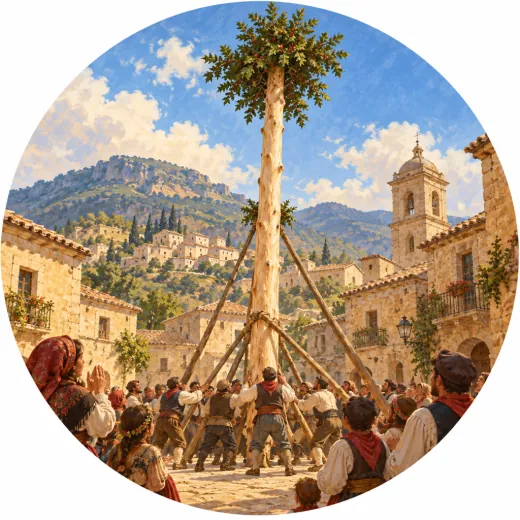
In Accettura, every year, two trees get married. In the Montepiano wood the men choose the tallest, straightest oak: it is the Maggio, the groom. In another wood they cut the top of a holly tree: it is the Cima, the bride, carried on shoulders for hours to the village. On the evening of Pentecost the Cima is joined to the top of the Maggio, and in the following days the tree is raised in the square among the crowd, but only in front of the relic of Saint Julian carried in procession. Some think the feast comes from ancient tree cults older than Christianity: it is a hypothesis, not a proven fact.
Did you know? Since the eighteenth century the wedding of the trees has been celebrated together with the feast of the patron saint, Saint Julian.
The story
In a mountain village of Basilicata, Accettura, every year, in spring, something happens that has made the village famous: it is one of the best-known tree festivals in Italy. Two trees get married.
It is not a figure of speech. It is a real festival, which the inhabitants call the Maggio, and which lasts for days. There is music, processions, bonfires, oxen, songs. And, at the centre of everything, a very tall tree that is raised in the square, in the middle of the crowd.
To understand how we reach that moment, we must start from the wood.
Accettura is surrounded by woods. On one side is the one at Montepiano, where the Turkey oaks grow, large and ancient oaks. On the other is the forest of Gallipoli Cognato, in the Park of the Small Lucanian Dolomites, with its jagged rocks. They are places where life seems slower, where the air smells of resin and wet earth.
The festival begins with a choice.
The inhabitants, usually the men most expert in the woods, look for the tallest and straightest oak of all. It must be perfect: a beautiful trunk, without flaws, that can withstand the weight of the festival. When they find it, they wait for the right moment. Usually they cut it down on Ascension Thursday, with care and respect.
That tree is called the Maggio. It is the bridegroom.
But a trunk tens of metres long is not brought into the village with a lorry, at least not in the tradition. The oxen drag it, a few days later. A long line of animals, yoked one after another, pulls the Maggio along the steep paths, through bends and climbs, for hours, to the gates of the village. The men walk beside it with sticks. There is effort, there is sweat, there is a little fear: a tree so big, on a road so narrow, can do harm.
The next day it is the bride's turn.
The bride is called the Cima and is a holly, a smaller, slimmer tree, with dark glossy leaves and red berries. No animal carries her. The young people carry her, on their shoulders, for long stretches. They climb and descend, shouting, laughing, singing, with that green plant balanced above their heads. The more the effort grows, the more the mood heats up.
Meanwhile the village is in festival. Saint Julian, the patron, is celebrated. The statue and the relic of the saint come out in procession. They say the cult of Saint Julian, at Accettura, was established in the eighteenth century, in 1725. And there is a story, which scholars report with caution, according to which in 1797 the procession with the saint's relic met the great tree. Thus, the two rites, the farmers' one of the tree and the Christian one of the saint, became intertwined.
The most awaited moment comes in the square.
The Maggio, the oak bridegroom, lies on the ground, surrounded by an enormous crowd. Someone plays. Someone prays. The Cima, the holly bride, is carried in front of the tree. Then she is mounted, fixed to the top of the trunk, usually on the evening of Pentecost. The two trees become one.
Then, in the days that follow, begins the hardest part: raising it. With ropes, with poles, with the strength of many people pushing together, the Maggio slowly begins to rise. They say it must not be fully raised unless the saint, that is his relic, is in front of it. When at last it stands straight, almost at ninety degrees, towards the sky, the square bursts into applause.
For the people of Accettura, it is the wedding, even if scholars argue over whether that is the right name. A wedding between two trees, between two woods, between the mountain and the village. In the old books that tell of these festivals it is written that it serves to make the land prosper, to bring fertility to the fields. Scholars say that perhaps these rites are much older than Christianity. But it is a supposition, not a certainty.
What we know for certain is that today the Maggio is a real festival, difficult and beautiful. A festival that unites people.
And also dangerous, now and then. On 9 June 2025, for example, some oxen were frightened by firecrackers and ran into the crowd: five injured, fortunately not seriously. A reminder: when you deal with nature and animals, you must respect them.
In Accettura there is also a museum dedicated to all this, the museum of tree cults. If you want to understand how and why the people of a Lucanian mountain decided, one day, to marry two trees, that is where you must go.
And perhaps you will understand that some festivals do not serve to explain anything. They serve to remind us that we are part of something greater.
Relatives around the world
Listen / Read next
- Music to read by: Cinematic JourneyEpic film-style music, no lyrics, by Ciro Simone IrmiciSpotifyYouTube Music
Sources
- Giovanni Battista Bronzini (a cura di), «Accettura: il contadino, l'albero, il santo», Galatina, Congedo (1979)
- ENIT, italia.it (portale turistico nazionale), «Accettura, borgo in Basilicata»
