The Monachicchio
“munaceddu”, little monk · Basilicata
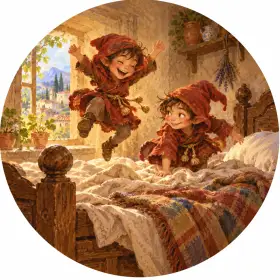
In Basilicata the monachicchi are small, cheerful sprites with a red hood who run around houses. They tickle the soles of your feet, knock over glasses of wine, hide things, pinch, pull hair and whistle like mosquitoes. They are not bad, just mischievous: their pranks look like a game. They are very fast and hard to grab: the only way to catch one, it is said, is to snatch its red hood with a lightning-quick move.
Did you know? The writer Carlo Levi, sent into internal exile in Lucania, wrote about the monachicchi in his most famous book, “Christ Stopped at Eboli” (1945).
Sources: Carlo Levi, «Cristo si è fermato a Eboli», Einaudi (1945); Meer, «Gli spiriti spiritosi della casa»
The Masciara
from “magic”, the village sorceress · Basilicata
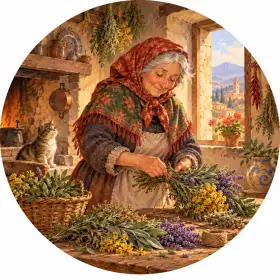
Every village in Lucania had its masciara: a woman who knew formulas, herbs and gestures to lift the evil eye, cure an ache or protect a child. People believed that an envious look, even an unintended one, could make you ill: they called it “affascino”, and the masciara knew how to undo it. For some she was a healer, for others a witch to keep away from. In the 1950s the anthropologist Ernesto de Martino travelled through these villages to understand why that magic mattered so much to people.
Did you know? Colobraro was known as “the village not to be named”, because it was said to bring bad luck: today it has turned that into a summer festival.
Sources: Ernesto de Martino, «Sud e magia», Feltrinelli (1959); SportOutdoor24, «Masciare, malocchio e il festival delle streghe: Colobraro»
The Maggio of Accettura
the wedding of the trees · Basilicata
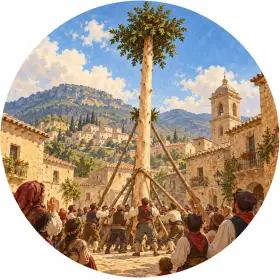
In Accettura, every year, two trees get married. In the Montepiano wood the men choose the tallest, straightest oak: it is the Maggio, the groom. In another wood they cut the top of a holly tree: it is the Cima, the bride, carried on shoulders for hours to the village. On the evening of Pentecost the Cima is joined to the top of the Maggio, and in the following days the tree is raised in the square among the crowd, but only in front of the relic of Saint Julian carried in procession. Some think the feast comes from ancient tree cults older than Christianity: it is a hypothesis, not a proven fact.
Did you know? Since the eighteenth century the wedding of the trees has been celebrated together with the feast of the patron saint, Saint Julian.
Sources: Giovanni Battista Bronzini (a cura di), «Accettura: il contadino, l'albero, il santo», Galatina, Congedo (1979); ENIT, italia.it (portale turistico nazionale), «Accettura, borgo in Basilicata»
The Madonna della Bruna of Matera
the feast of 2 July · Basilicata
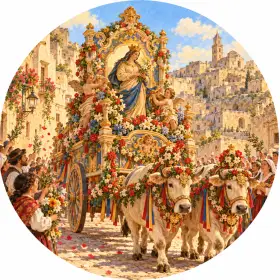
A legend from Matera says that a farmer gave an unknown girl a ride on his cart. She handed him a message for the bishop and vanished at Piccianello: in the message she revealed that she was the Madonna and asked to stay in Matera. The clergy found an image of the Virgin on a decorated cart and carried it in triumph to the cathedral. Since then, every 2 July, the Madonna della Bruna is carried into town on a triumphal cart. At the end of the feast the crowd storms the cart and destroys it, a custom that became established at the end of the nineteenth century. The following year the cart is made again from scratch.
Did you know? It was Pope Urban VI, formerly archbishop of Matera and Acerenza, who set the feast of the Bruna on 2 July, linking it to the Visitation.
Sources: Associazione Maria SS. della Bruna, «Storia» della festa; Fondazione Matera-Basilicata 2019, «Il giorno più lungo» (copia archiviata)
The Holy Grail of Acerenza
the chalice behind the little window · Basilicata
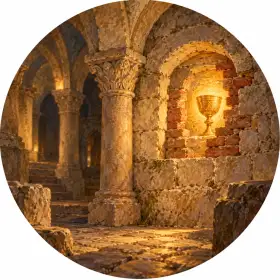
Acerenza is a village perched on top of a hill, with a large Romanesque cathedral. In the crypt, restored in 1524, there is a bricked-up little window, and according to a legend the Holy Grail, the cup of the Last Supper, is hidden behind it; according to this theory, the Knights Templar might have brought it here. It is worth knowing that this is a recent legend, which became famous in recent years thanks to books and articles by enthusiasts, and there is no historical evidence. The cathedral and the crypt, on the other hand, are old and real.
Did you know? The Grail appears in many European legends: in the stories of King Arthur the knights of the Round Table set out precisely to look for it.
Sources: FAI, Fondo per l'Ambiente Italiano, I Luoghi del Cuore, «Cattedrale di Santa Maria Assunta e San Canio Vescovo, Acerenza»; SiViaggia (sito di viaggi), «Il borgo della Basilicata dove è custodito il Sacro Graal»