The Holy Grail of Acerenza
the chalice behind the little window
not scary at all
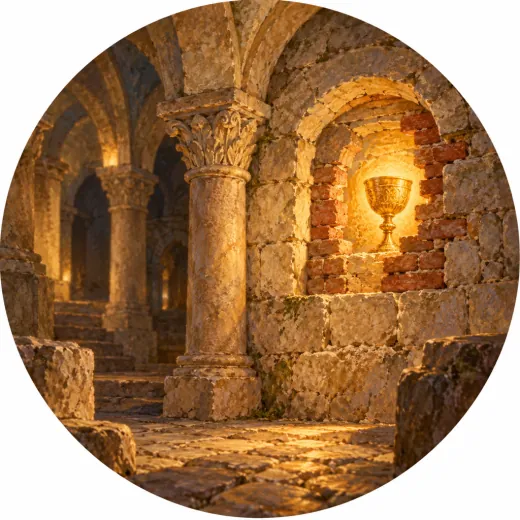
Acerenza is a village perched on top of a hill, with a large Romanesque cathedral. In the crypt, restored in 1524, there is a bricked-up little window, and according to a legend the Holy Grail, the cup of the Last Supper, is hidden behind it; according to this theory, the Knights Templar might have brought it here. It is worth knowing that this is a recent legend, which became famous in recent years thanks to books and articles by enthusiasts, and there is no historical evidence. The cathedral and the crypt, on the other hand, are old and real.
Did you know? The Grail appears in many European legends: in the stories of King Arthur the knights of the Round Table set out precisely to look for it.
The story
Acerenza is one of those villages of Basilicata that seem built to hide something. It stands on top of a crag, surrounded by Aglianico vineyards, with stone houses packed close together and alleys that climb. From above it looks like a medieval citadel. And in the middle of all this, almost suddenly, at the end of a narrow street, the cathedral appears.
It is enormous. Too big for such a small village. For this reason they call it "the city-cathedral".
It is dedicated to Santa Maria Assunta and to San Canio, a bishop. And, according to some people, it guards the most famous secret in the world.
The Holy Grail.
For those who do not remember, the Grail is the chalice of the Last Supper. Tradition says that after the crucifixion of Jesus, a man named Joseph of Arimathea used it to collect the blood of Christ. Whoever drinks from the Grail, it is told, obtains eternal life and knowledge. It is the cup that the knights of King Arthur sought in their adventures. Nobody knows where it ended up.
According to the people of Lucania, or at least some of them, it ended up at Acerenza.
Now, it must be said at once, because it is right to do so: this is not an ancient legend. There is no medieval document that says it. It is a modern story, which became famous above all after 2016, when a travel journalist, Isa Grassano, originally from Basilicata, spoke of it in a book, "Forse non tutti sanno che in Italia...", "Perhaps not everyone knows that in Italy...". She herself says that it is neither legend nor history, but a mystery. A mystery made of clues.
Let us look at them, one at a time. And let us put them, as in detective stories, in order.
The first clue is the Templars. These are the knight-monks founded in 1118 by a man called Hugh of Payns, in Italian Ugo dei Pagani. According to this thesis, Hugh was born at Forenza, a village near Acerenza; historians usually say he was born at Payns, near Troyes, in France. In 1227, during the Sixth Crusade, the area was supposedly a stopping point for the troops. The archbishop of the cathedral at that time, a certain Father Andrea, supposedly had a role in organising that expedition. And Hugh of Payns, or someone of his order, supposedly hid the Grail in the cathedral.
The second clue is a name. One of the squares of Acerenza is called Piazza Glinni. The author points out that it could derive from a Gaelic word, glin, and Gaelic, she recalls, is also the legend of the Grail.
The third clue is in the crypt. The crypt of the cathedral was restored in 1524 by Count Ferrillo Balsa, who belonged to the Order of the Knights of Jerusalem. During that restoration, someone walled up a small window. Why? Nobody explains. But whoever loves mysteries thinks at once: perhaps they hid something behind it.
The fourth clue concerns the saint. The name San Canio, in Gaelic, would mean something like "magnificent guardian". And then one wonders: guardian of what?
The fifth clue is the name of the village. Acerenza could derive from Acheron, the river that, in Greek mythology, separated the kingdom of the living from that of the dead. A border place, then. A suitable place to hide something that belongs to other worlds.
End of the clues.
Now comes the honest part. None of these things has a documentary source to prove it. That Hugh of Payns was born at Forenza, that Father Andrea had that role, that the Gaelic words have anything to do with it: all this is interpretation, hypothesis, or local tradition. Those who tell the story themselves use the conditional. "Would be", "could be", "suggests".
And there is another problem, an amusing one. Even if someone wanted to look for the Grail, they would not know where to look. The cathedral has many windows. Nobody has established which is the right one. None has been opened. The Grail, says the author, could be hiding around every corner.
Meanwhile, the book has had a real effect: since 2016 more tourists have come to Acerenza. They come for the Grail, and they find a beautiful village, an extraordinary cathedral, a view over vineyards and hills, and the atmosphere of a timeless hamlet. Many leave without having found the chalice. But happy.
Perhaps this is the true treasure. A question left open, in a place beautiful enough to afford not to answer.
Relatives around the world
Listen / Read next
- Music to read by: Cinematic JourneyEpic film-style music, no lyrics, by Ciro Simone IrmiciSpotifyYouTube Music
