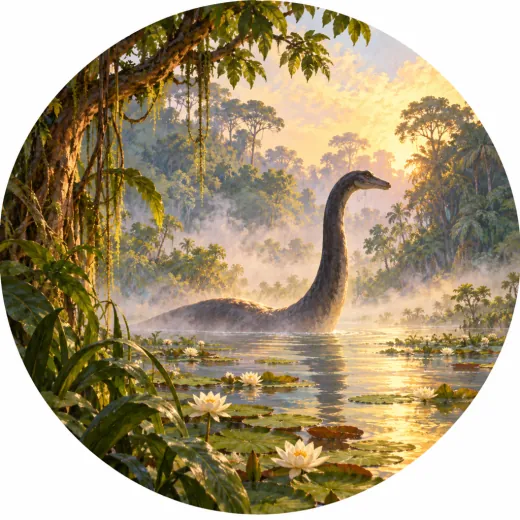
Mokele-mbembe
“one who stops the rivers”, in Lingala
a little scary
Mokele-mbembe is a creature talked about in the stories of the swamps of the Congo basin: an animal as big as an elephant, with a long neck and a sturdy tail, said to live in the rivers and in Lake Tele. Its name, in Lingala, means more or less “one who stops the flow of rivers”. In the twentieth century many European and American explorers set out to look for it, convinced it was a surviving dinosaur. Nobody has ever found any proof: scientists think it is a story, perhaps inspired by rhinos, elephants, hippos or large crocodiles.
Did you know? As early as 1776 a French book about the kingdom of Loango reported that some missionaries had seen huge footprints of an unknown animal in the forest.
The story
Imagine a village on the edge of a swamp, in the north of the Congo, at sunset.
The air is thick and hot and smells of mud. Mosquitoes sing above the black water. In a clearing, round a low fire, an old fisherman is mending a net, and the children sit around him, barefoot and wide-eyed.
“There's a place on the river,” says the old man, “where the water stays still even when it rains. It's not a good place for canoes.”
“Why?” asks one of the children.
“Because someone lives there who doesn't want to be disturbed.”
The fire crackles. Somewhere far away a frog cries out once, then falls silent. A child hugs his knees.
“Its name is Mokele-mbembe.”
I made this scene up: there is no old man and no fire. But tales like this really have been collected in that region, by many people, over many years. In the Congo basin, where the forest is so thick it can hide a village for months, people have always talked about an animal as big as an elephant, with a long neck and a sturdy tail, said to live in the rivers and in Lake Tele, in the middle of the Likouala swamps. Lake Tele is small, almost round, and to get there you have to walk for days through flooded forest, with water up to your knees and mud sucking at your boots.
Its name, in Lingala, means more or less “one who stops the flow of rivers”. A name like that makes you think of something enormous, something that stops the water when it passes.
The first time anything like it appeared in a European book was in 1776. A French book about the kingdom of Loango, an old kingdom on the coast of Central Africa, told how some missionaries walking in the forest had found enormous footprints. Deep, wide prints of an animal none of them recognised. They did not see the animal. They saw only the tracks, and the rest, as often happens, was built by imagination.
Then, in the 20th century, the story changed.
In Europe and America the newspapers were full of dinosaurs. Gigantic skeletons were being discovered, and children drew them in their exercise books. So when explorers heard about an animal with a long neck and a thick tail, someone thought: what if it's a dinosaur? What if one of them survived, hidden in swamps where nobody has ever gone?
One of the most convinced was Roy Mackal, an American biochemist and virologist from the University of Chicago. In 1980 and 1981 he set off for the Congo with other researchers, and for weeks he travelled up the rivers of the Likouala, on foot, by boat, through mud, in heat so fierce that at midday nobody felt like talking. He spoke with fishermen, hunters and villagers, including Pygmy communities. He collected a great many stories. He turned them into a book, in 1987, called A Living Dinosaur? The question mark in the title is honest.
Here is what he found. Eyewitness accounts: lots. Descriptions: similar, but not the same. Drawings. An area nobody had ever really explored. What he did not find was a body, a bone, a skin, an egg, a clear picture. The expeditions came home with full notebooks and empty hands. Others followed in the decades after, from different countries, and the ending was always the same.
In 1983 a Congolese biologist, Marcellin Agnagna, said he had seen a long-necked animal in a lake in the region, for a few minutes. An important account, from a scientist. But that too remained an account: no photo, no film that showed everyone the same thing. One person says they saw it. The others cannot check.
Here we have to stop and understand a difference, because it is the most important part of the story.
An eyewitness account is someone telling you they saw something. Proof is something anyone can check: a bone, a sharp photograph, a live animal in a cage. Eyewitness accounts are precious, but they can be wrong. It happens to everyone. In the dark, in the water, after a long, tiring day, an elephant swimming with its trunk raised can look like a long neck rising out of the river. A hippo on the bank, a big crocodile, a floating log. When a story is already in the air, our eyes tend to find in things what they expect to see.
There is something else the sceptical researchers point out, such as Daniel Loxton and Donald Prothero in their book about the “monsters” science has never found. If you show someone a drawing of a dinosaur and ask, “Does it look like what you saw?”, they may say yes out of politeness, or because they do not want to disappoint you. That way, the answers become less clear.
That is why almost no scientist today believes Mokele-mbembe is really a surviving dinosaur. The giant long-necked dinosaurs died out about sixty-six million years ago, and in a swamp, however vast, there would have to be skeletons, eggs, fresh footprints. Instead there is nothing.
And yet the story remains. And it is worth understanding why.
Perhaps because the swamp really is a huge and almost unknown place, and when a place is like that, the mind fills it up. Perhaps because the real animals that live there, forest elephants, hippos, Nile crocodiles, are already big enough to make us feel small. Perhaps because a story about a mysterious animal is, above all, a story about paths nobody knows. And perhaps because, when you are a child, the bottom of a river is more frightening than anything you can see.
At dawn, the old fisherman's canoe slips away from the bank without a sound.
The place where the water stays still is still there. Whether something really lives beneath it, or only water and stories, the river does not say.
A living tradition, told with respect: how we tell myths.
Relatives around the world
Listen / Read next
- Music to read by: Cinematic JourneyEpic film-style music, no lyrics, by Ciro Simone IrmiciSpotifyYouTube Music
Sources
- Daniel Loxton and Donald R. Prothero, Abominable Science!, Columbia University Press (2013)
- Roy P. Mackal, A Living Dinosaur? In Search of Mokele-Mbembe, Brill (1987)
