Ogun
Ògún, in Yoruba
a little scary
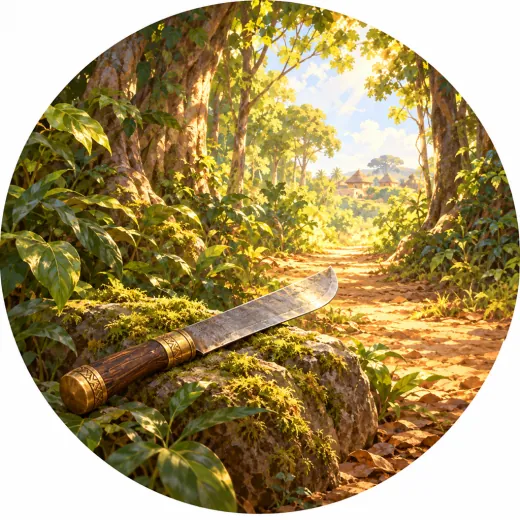
Ogun is the orisha of iron, of blacksmiths, of hunters and of everyone who works with metal tools. Tradition tells that, in the beginning, the orishas wanted to come down to earth but a very thick forest blocked the way. No one could get through, until Ogun took his iron machete and cleared a path for everyone. That is why he is the god who opens the way. Today he is also considered the protector of drivers, mechanics and people who work with machines.
Did you know? Iron is sacred to Ogun, and in West Africa it is used to guarantee oaths, even in courts of law.
The story
Before there were roads, there was the forest.
The orisha looked down on it from the sky, leaning over the edge of the clouds. Below them lay the earth, green and dark, covered with trees so close together that their branches wove into each other like fingers. Not even light reached the ground. No god knew what was hidden down there. They only knew that the earth was waiting to be lived in, and that the job was theirs.
“Let’s go down,” said one.
“And how?”
So they began to try. Each of them took the tool they used to open a way in the sky, and started hacking at the tangle of vines and branches. They were beautiful blades, shining, fit for a god. But the trunks were hard and the vines were stubborn, and after a few blows the edges bent, chipped and went blunt. The orisha sweated, looked at one another, tried again. The forest stayed exactly as it was. By evening their hands were covered in blisters, and in front of them there was not even a gap as wide as a man.
That was when Ogun stepped forward.
He did not carry a beautiful weapon. He carried a machete of iron, black and heavy, made by his own hands. Iron belonged to him: he knew it the way you know a brother. He knew how much fire it needed to glow red, how much hammering to grow strong, how much water to turn hard. Above all he knew something the others had forgotten: iron does not bend, if it has been beaten well.
He stopped in front of the wall of green. He took a breath. Then he raised his arm.
Tak.
A branch as thick as a thigh fell to the ground.
Tak. Tak. Tak.
The sound was steady, like a beating heart. Ogun did not rush and he did not stop: he struck, took a step, struck again. The vines came away, the bushes parted, the young trees fell like stalks of grain. Behind him the path grew, step by step, and something nobody had ever seen began to trickle down from above: a thin strip of light, touching the earth for the very first time.
The other orisha followed him in silence. Some gathered up the branches and set them aside. Someone, they say, noticed that Ogun’s dog was trotting beside him, tongue hanging out, looking up at him as if clearing a forest were the most ordinary thing in the world.
Ogun worked for a day and a night, and then another day. He did not ask for water. He did not ask for rest. When the machete grew too hot, he plunged it into the current of a stream, heard the hiss of the steam, and carried on.
At last the forest opened in front of him like a curtain. On the other side lay a wide plain, under a sky that could finally be seen whole. The orisha came down one after another, and their feet touched the earth.
For a moment nobody spoke. Then someone laughed, and someone else knelt to touch the soil.
To thank him, the gods offered to make him their leader. In the stories, at this point, Ogun looks around and understands what that would mean: sitting up high, giving orders, resting on a throne while someone else does the work. It did not seem like a life for him. He refused, politely.
“I am the one who opens the way,” he said. “Not the one who gives orders.”
He went off to Ire, a town on a hill, and there the people welcomed him as their king. There, the stories say, he taught people what he knew how to do: smelt ore in the furnace, beat hot iron on the anvil, sharpen the hunter’s spearhead, the blade for the field, the nail for the house. Whoever learned from him learned to respect fire, because fire does not forgive those who treat it badly. Ogun was a stern king, and a fair one. That is why they called him the god of blacksmiths, warriors and hunters. That is why, even today, people who work with metal call on him.
But the stories of Ire do not hide the fact that even a god can grow weary.
One day Ogun came back from a long war. He had fought for his people, slept little and eaten worse, and when he reached the town he was parched. They offered him palm wine, and then more wine. And that time, the wine clouded his mind. The old people do not tell everything, and they are right not to: they only say that in his confusion Ogun no longer recognised the faces around him, and that his strength turned against his own men.
When the fog lifted, the square was silent.
Ogun looked at his hands. He looked at the machete. He did not shout. He was a god, but he still felt the weight of what he had done, and that weight was heavier than any tree he had ever cut down.
Then he made a choice no king had ever made. He did not make excuses and he did not look for someone else to blame. He gave up his crown. He drove the machete into the ground, right there in the middle of Ire, and the earth opened beneath him. Ogun went down into it, and the ground closed over him. Where he had stood there was only a patch of red dust, and a long trail of sparks that rose for an instant towards the sky.
But he did not leave for ever. The faithful say that Ogun is not dead: he has passed into the earth, into iron, into the forge. You can hear him every time someone strikes a blade on an anvil and the sound bounces off the hill. You can find him in the lorry setting off on a long journey, and in the workshop where an oily hand grips a spanner. You can find him wherever a road is opened.
Because this is what he taught before he disappeared: that no path exists until someone has the courage to strike the first blow. And that when you walk along a road that others opened for you, you should remember, at least for a moment, the sound of that machete.
Tak. Tak. Tak.
A living tradition, told with respect: how we tell myths.
Relatives around the world
Listen / Read next
- Music to read by: Cinematic JourneyEpic film-style music, no lyrics, by Ciro Simone IrmiciSpotifyYouTube Music
Sources
- Sandra T. Barnes (ed.), Africa's Ogun: Old World and New (1989)
