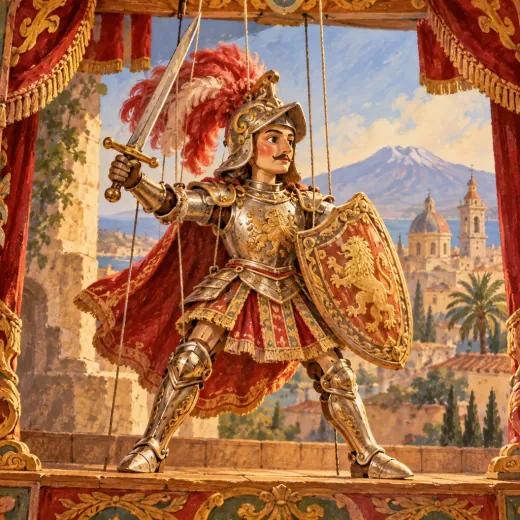
The Pupi and Orlando
“l’Opra dî pupi”, in Sicilian
not scary at all
In Sicilian puppet theatres, wooden marionettes in shining armour tell the deeds of Charlemagne's paladins: Orlando, the strongest of all, his cousin Rinaldo, the traitor Gano of Maganza, the battles against the Saracens and the love for beautiful Angelica. The stories come from chivalric poems such as Ariosto's “Orlando Furioso”. The puppeteers moved the pupi with iron rods, the main one running through the head, often improvised the lines, and one story could go on in instalments, night after night, for months.
Did you know? The Opera dei Pupi was proclaimed by UNESCO in 2001 and inscribed in 2008 on the Representative List of the Intangible Cultural Heritage.
The story
At eight in the evening, in that alley in Palermo, the door of the little theatre opens, and inside there is already half the city.
You go in. The hall is small and smells of old wood. The seats are almost all taken: workmen, women with their shopping, grandfathers with caps in hand, boys piled up in the front row. The puppet theatre is for them. It always has been, ever since it took hold in Sicily in the nineteenth century: it is the entertainment of working people, where nobody has to explain anything to anyone.
At the back of the stage is a painted cloth, as big as the stage. Beneath it, the poster of the evening. It is in tempera, divided into eight panels, eight "scacchi", and each panel is a scene of the story. Beside it hangs a sheet with a single word: "Oggi", Today. It marks tonight's episode.
Because the story of the pupi (the puppets) never ends. It goes on evening after evening, for weeks, for months. Every day everyone is left in suspense, and every day they come back to find out what happens.
The barrel piano strikes up a tune. The lights go down. The curtain rises.
And there he is.
The puppet is about ninety centimetres tall. It seems little, but he weighs from five to ten kilos, because he is covered in real armour, which gleams under the lamps like silver. He has a painted face, big eyes, an expression that from a distance looks alive. He has knees that bend. He walks forward, bows, and when he puts his hand on the hilt, the sword comes out of its scabbard with a rustle and a flash: behind, hidden, there is a thread that passes inside the right hand, and it is enough to pull it.
But the hall does not think about the thread. The hall looks at him. He is Orlando, the strongest of all Charlemagne's paladins.
Behind the scene, on the right, stands the puparo, the puppeteer. He moves the puppet with an iron rod that passes through its head and joins it to the torso, with a hook at the top. And with his mouth he does all the characters: the hoarse voice of the emperor, the sweet one of Angelica, the dark one of the traitor. He makes the sounds too, the blows, the lights. He has no script. Most of the lines he invents on the spot, watching the faces of the audience, sensing whether they laugh or hold their breath.
Tonight the story goes like this.
Charlemagne is in his camp, and the Saracens are near. Rinaldo, Orlando's cousin, appears from the right, helmet on his head and a strong voice. He says they must attack at once. Then in comes Gano of Maganza.
When he enters, the hall whistles. It always has. He is the traitor, the one who always smiles a little too much, and bows a little too low. They call him by name, loudly, with affection and contempt together. The puparo gives him a thin, honeyed voice, and he speaks to Charlemagne with sweet words, like a cat. Meanwhile, on the left, someone mentions Angelica, the beautiful Angelica, and Orlando stops, turns, puts a hand to his chest. The audience laughs: they already know how it will end, or rather they know it and still want to hear it said.
Then the battles begin.
It happens suddenly. The puparo stamps his foot on the stage: one beat, one beat, one beat. The clog sounds like a drum. The puppets throw themselves at each other. The armour clashes, the swords clink, and the rhythm of the blows builds, faster and faster, louder and louder, until you can no longer tell who is winning and who is losing. It is a dance, more than a fight. The boys in the front row jump on their chairs. A grandfather shouts something in dialect at a Saracen.
Orlando drives in the blow. An enemy falls. Another. The audience screams with joy.
When everything stops, in the hall you hear only the breathing of the people, and the puparo, behind the wings, breathing hard.
Luckily there is also something to laugh at. Between one battle and the next, in Palermo, two bumbling servants come on stage, Nofrio and Virticchio, with their farces and quarrels. In Catania, instead, the comic is Peppininu, the squire of Orlando and Rinaldo. In Catania the puppets are bigger, even a metre and thirty, and weigh up to thirty kilos. They do not have bending knees, and so the warriors almost always keep the sword in hand. The operators, the manianti, move them from a high bridge, behind the backdrop, while others, the parraturi, speak the lines hidden behind the wings.
The episode ends at the best moment, as always. Gano has set up a trick. Orlando does not know. The curtain closes and from the hall rises a long "oooh" of reproach.
Tomorrow evening it begins again.
Once upon a time the pupari competed over who could bring in more people. Then the world changed: with the economic boom of the 1950s many theatres closed, and today the pupari struggle to make a living from this trade. But it has never died out. Proclaimed in 2001 by UNESCO, it was inscribed in 2008 on the list of the intangible heritage of humanity.
When you come out, the street is cold and dark. But you, for a moment, still have in your ears the puparo's clog on the stage, and you see a puppet in shining armour raise his sword, against the dark.
Relatives around the world
Listen / Read next
- Music to read by: Cinematic JourneyEpic film-style music, no lyrics, by Ciro Simone IrmiciSpotifyYouTube Music
- The words of the dialect: SicilianNonnese, the dictionary of Italian dialects
Sources
- Ministero della Cultura, Ufficio UNESCO, «Opera dei Pupi, teatro siciliano dei pupi»
- Ludovico Ariosto, «Orlando furioso» (1532)
