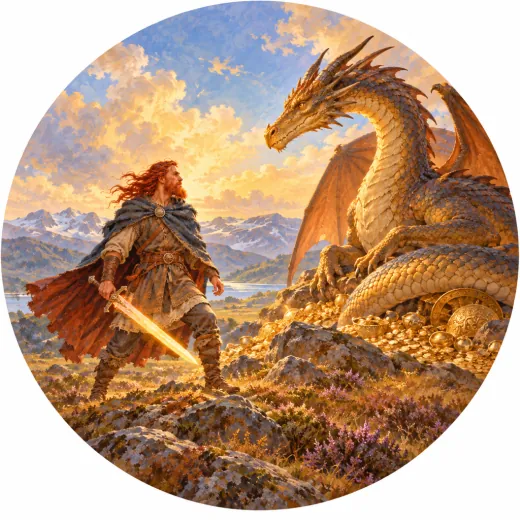
Sigurd and the Dragon Fafnir
Sigurðr and Fáfnir
scary
Fafnir was a man so greedy that he turned himself into a dragon to guard a cursed treasure all by himself. The young hero Sigurd, armed with a sword reforged from the pieces of his father's blade, dug a pit on the path the dragon took to go and drink, and struck him from below. While he was roasting the dragon's heart, he burned his finger and put it in his mouth: as soon as he tasted the blood, he began to understand the language of the birds, who warned him of a betrayal.
Did you know? Centuries later this saga inspired Wagner's cycle of operas and also some modern fantasy novels.
The story
Nobody had set foot on the heath of Gnitaheiðr for years.
The path was still there. It was wide, gouged into the earth, and it looked like the track of a landslide. No sheep walked along it, and no person either. The dragon went that way every day to drink at the river, and wherever he passed, the grass turned yellow and the ground stayed bare and shiny, as if it had been smeared with oil.
His name was Fafnir. Once, he had been a man.
It had all started with a treasure of red gold, cursed from the very beginning: a dwarf's gold, with a ring that brought misfortune to anyone who touched it. Fafnir had wanted all of it for himself. To get it, he had not stopped even at his own father. Then, afraid that someone would take it from him, he had put on a helm of terror, and so he had changed: he had become an enormous serpent who slept on top of the gold and never left it. Greed had not made him rich. It had made him a beast.
His brother Regin, a smith, had got nothing.
That was why, years later, Regin brought up a boy, Sigurd, the son of Sigmund. He taught him to read, to ride, to speak with kings. Then one day he told him the truth.
“There's a dragon on the heath. He sleeps on gold. Kill him, and the treasure will be yours.”
Sigurd agreed, but he asked for a sword worthy of the task.
Regin forged one. Sigurd tested it on the anvil, and the blade broke. Regin forged a second, and that one broke too. So Sigurd went to his mother and asked for the pieces of his father's sword, which she had kept wrapped in a cloth for years and years. Regin put them in the forge. He worked for a long time, with the fire roaring, without saying a word.
When the new blade came out, its name was Gram, and it was black and gleaming. Sigurd brought it down on the anvil with all his strength. The anvil split in two, from its edge right down to its block. Then he dropped a tuft of wool into the river, and as it floated past, the blade cut it in half.
Then they went to the heath.
Regin stopped short of it. “The dragon comes this way,” he said, and pointed at the path. “Dig a pit, get inside it, and when he goes over, strike him from below. I'll come back later.”
He left without looking back. Sigurd was alone.
He picked up the spade. He began to dig in the middle of the path, where the earth was hard and cold. He dug, and there was nothing to see around him, only a low sky and a wind blowing from far away.
Suddenly he saw someone. An old man, leaning on a staff, with a long beard, who looked at him as if he already knew everything.
“What are you doing, boy?”
“Digging a pit for the dragon.”
“Dig more pits,” said the old man. “One for the blood, one for the rest. If you get into just one, the blood will drown you.”
And he vanished, silently, the way he had come. Sigurd hadn't had time to ask his name. But he did as he had been told.
Then he lowered himself into the pit and waited.
Time passes slowly in a pit. Sigurd could feel the wind above him and his heart in his chest. Then he felt something else.
The ground was shaking.
Not much, at first. A deep rumble, rising up through his feet. Then stronger. Pebbles rolled down the sides of the pit. Something huge was moving, slithering, coming closer. Sigurd smelt it before he saw it: bitter, like burnt copper. Then a shadow covered the sky, and the dragon's body passed over him.
It was long, endless, covered in scales. Poison dripped from his snout and fell smoking onto the path. Sigurd saw the pale belly a hand's breadth from his face. He raised Gram with both hands and drove it upwards, up to the hilt.
The dragon screamed. Then he went silent. He crashed down on the far side of the path with a thud that shook the heath, and the ground stopped trembling.
Sigurd climbed out of the pit, shaking, his arms filthy up to the elbows. Fafnir lay on the ground, breathing slowly. His eyes, huge and yellow, watched him with no anger left in them.
“Who are you?” said the dragon. “Who is your father?”
“They call me the noble beast,” answered Sigurd. He did not want to give his real name: people believed that the curse of a dying man had power. They talked for a long time. Fafnir said that his gold brought misfortune to whoever owned it, and that Sigurd would be no exception. He also said that Regin, his brother, meant to kill Sigurd. Then he died.
Regin came back at midday. He sat down beside his brother's body and looked at Sigurd with lowered eyes.
“You have killed my brother. Roast his heart for me, boy. I want to eat it.”
Sigurd lit a fire. He pushed the heart onto a stick and turned it over the flames. At one point he stopped: he wanted to know if it was cooked. He touched it with his finger and burnt himself. At once he put his finger in his mouth, and he tasted something different.
From that moment on, he understood the birds.
Above him, on a branch, sat some nuthatches, tiny birds chattering to each other.
“Look at Sigurd,” they were saying. “He trusts Regin. But Regin thinks of nothing but betraying him.”
“If he had any sense, he would kill Regin first and take the treasure for himself.”
Sigurd looked at Regin, who was watching him out of the corner of his eye. He understood everything. He gripped Gram. He ate the heart himself, down to the last piece, and Regin never had the chance to betray anyone again.
Then the birds told him about something else, further away, on a mountain ringed with flames, where a woman lay asleep. But that is another story.
Sigurd went into the dragon's lair, where the walls glittered. Down there lay the gold, so much of it that his horse, Grani, could barely carry it.
He set off at sunset. Behind him he left the heath, the pit and the empty path. The wind ran across the yellow grass.
And with the gold, just as the dragon had said, travelled the curse.
Relatives around the world
In the trails
Listen / Read next
- Music to read by: Cinematic JourneyEpic film-style music, no lyrics, by Ciro Simone IrmiciSpotifyYouTube Music
Sources
- Poetic Edda, Fáfnismál
- Völsunga Saga (13th century)
