Colapesce
“Cola Pisci”, Nicholas the fish
not scary at all
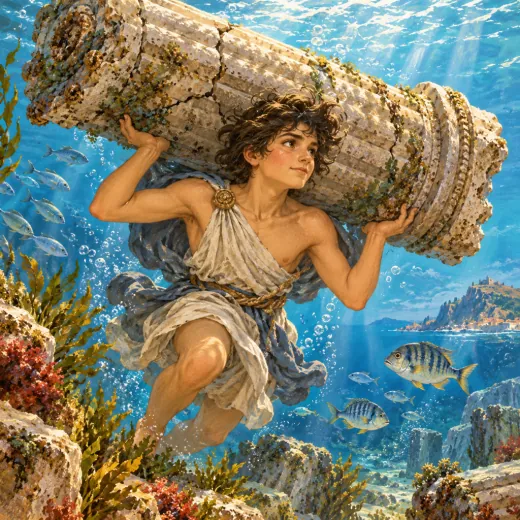
Nicholas was a boy from Messina who spent more time in the sea than on land, so much that he became half fish. The king put him to the test: he made him bring back a golden cup thrown into the sea, then a crown, then a ring, deeper and deeper each time. On his last dive Nicholas discovered that Sicily rests on three columns and that one of them was cracked by the fire of Etna: so he decided to stay down there and hold it up, to keep the island from sinking. In the oldest versions, he simply never comes back up.
Did you know? When there is an earthquake, people say Colapesce has shifted to rest his shoulder.
The story
In Messina, where the Strait is so narrow that you feel you could touch Calabria with a jump, and where the sea changes colour with every hour, every cloud, every breath of wind, a boy was born whom the old people would never forget.
His name was Nicola. But everyone called him Cola, and when he grew up they called him Colapesce, Cola the Fish. Because for him the sea was not a place to go to. It was home.
His father and his grandfathers were fishermen, and Cola had grown up on the boat, among the nets and the crates of sardines, with the smell of salt and pitch in his clothes. But while other boys waited to become men before diving in, he threw himself into the water before he could even walk properly. He swam like a fish, in fact better: he stayed down so long, so very long, that those on the shore began to count, then to pray, then to cry. And then he would surface, laughing, with his hair wet and his eyes shining.
"Where have you been?" his mother would ask, her heart in her mouth.
"Down there," he would answer. "I have seen things, Mamma, that you cannot even imagine."
And he told her. Forests of seaweed that sway like hair. Blue caves where the light comes in stripes, as through a broken window. Fish as big as boats, fish as small as coins, shining in a thousand colours. Sometimes he brought something up: an enormous shell, a red coral, even a piece of an old ship with gold coins inside.
His mother listened, but she was not happy. She was afraid. "The sea is not made to live in," she told him. "One day it will take you." And then she would get angry, and sometimes, on the worst days, she shouted things she did not mean. They say that in an older version of the story, in a moment of rage, she cursed him: "May you become a fish!" But of those words, in the end, you can never tell whether they came true or whether it was simply the sea, which had made its choice long before.
Meanwhile Cola's fame ran from village to village. People told of a boy who stayed underwater as if on dry land, who came back with treasures, who knew things that no man knew. The news reached the ears of the king.
In those days, in Sicily, Frederick II of Swabia reigned, a curious sovereign, who wanted to know everything, who collected books, strange animals, scholars from every country. When he heard of Colapesce, he could not resist. He had him summoned to court.
Cola came into the hall with bare feet and hair still damp. He bowed, without fear.
"They tell me you stay underwater longer than a fish," said the king. "I want to see if it is true."
They took him to the shore, near the Lighthouse, where the Strait is deepest and the currents fiercest. The king, in front of the whole court, took from a servant's hand a golden cup, beautiful, glittering, and threw it into the sea with all the strength he had.
"Bring it to me," he said.
Cola did not hesitate. He dived. The court stayed silent, watching the water close over his head. Minutes passed. Somebody began to murmur. Then, all of a sudden, a shadow appeared in the water, and Cola surfaced, smiling, with the cup in his hand. Amid applause, he handed it to the king.
The king smiled. But he was not yet content.
"Well done," he said. "But it is not enough. This time you will go deeper."
He took from his head the crown, the golden crown with precious stones, the one he wore every day. He made it flash in the sun, and hurled it further out, where the sea was as dark as ink.
"Bring me this."
Cola watched the crown vanish beneath the waves. He felt something squeeze his chest, but he dived again. This time so long passed that people began to shout, to cross themselves, to say that the boy was dead. The king himself, with his hand on his chin, no longer smiled.
And then, at last, a head surfaced. Cola, tired but alive, with the crown clutched in his hand and a strange, faraway expression, as if he had seen something that could not be told.
The king took the crown. But he had seen that look.
"What is down there?" he asked.
"Down there is a world, Majesty," answered Cola, softly. "A world that nobody has ever seen. And down there, at the bottom, there are things you would not like to know."
But the king was not satisfied. Curiosity was stronger than prudence. He took a ring from his finger, a gold ring with an emerald as big as a walnut, and showed it to Cola.
"One last time. I shall throw this into the deepest spot. And you will go and fetch it, and then you will tell me everything you have seen."
Cola lowered his eyes. He looked at the sea, then at the king, then at the shore where his mother, in the crowd, was watching him with her hands on her face. He understood that this dive would be different. He felt it in his bones.
"Majesty," he said, "I will go. But if I do not return, remember that I did it because you asked me."
The king did not answer. He threw the ring.
And Cola dived.
This time he went deeper than he had ever been. The water grew colder and darker. The voices from the shore grew distant, ever more distant, until they vanished. Around him there were no more fish, no light, no sound. Only a silence as dense as stone.
And then, at the bottom, in the dark, he saw something.
Three enormous columns, very tall, rising from the seabed until they were lost above, under the island. They were the columns that held up Sicily. One under Cape Peloro, where Messina stands. One under Cape Passero, at the far end beyond Syracuse. One under Cape Lilibeo, on the side of Marsala. On those three columns, since time began, rested all of Sicily, with its cities, its fields, its mountains, its churches.
Cola drew near. And he saw that one of the columns was crooked, chipped, full of cracks. They say it had been worn away by the fire of Etna, which for centuries had burned down there, in the bowels of the earth. One more crack, one more shock, and that column would collapse. And with it, all of Sicily would sink into the sea.
Cola stood still, in the dark, looking.
He thought of his mother on the shore. He thought of his home, his boat, the fishermen who sailed in the morning singing. He thought of the children of Messina playing on the beach, of the women hanging out washing, of the old men sitting at their doors. He thought of all those who did not know, and never would.
And he understood what he had to do.
He put his shoulders against the cracked column. He opened his arms. And he held it up.
On the shore, the king waited, and the crowd waited, and the mother waited. Ten minutes passed, then twenty, then an hour. The sun began to sink behind the hills of Calabria. Nobody saw that head surface again.
They say that the king, that evening, went back to the palace without saying a word. He had lost his ring, and the most extraordinary young man he had ever known.
But the story, in Messina, does not end here.
Because the old people say that Cola is still down there. That for centuries and centuries he has been under the sea, with his back against that column, and that now and then, when the effort is too great, he shifts to rest a shoulder. And then the earth trembles. The sea stirs. The houses sway. They say this is how earthquakes are born.
And every hundred years, they tell, Colapesce comes up. He goes to see how things are. He looks at the coasts, the houses, the boats rocking in the harbour. And then, with a sigh, he goes back down.
That is why, still today, in Messina, when a fisherman goes out to sea at dawn, and the sea is smooth as glass and the sky is barely pink, now and then someone on the boat stops and greets the water with a wave of the hand.
You never know. Perhaps, down there, someone waves back.
Relatives around the world
In the trails
Listen / Read next
- Music to read by: Cinematic JourneyEpic film-style music, no lyrics, by Ciro Simone IrmiciSpotifyYouTube Music
- The words of the dialect: SicilianNonnese, the dictionary of Italian dialects
Sources
- Giuseppe Pitrè, «Studi di leggende popolari in Sicilia» (1904)
- Italo Calvino, «Fiabe italiane», Einaudi (1956)
