Saint Francis of Paola and the Cloak
the crossing of the Strait
not scary at all
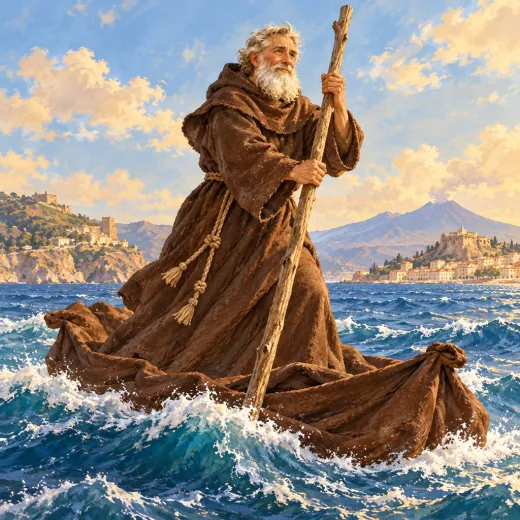
Francis was a friar from Paola who wanted to cross the Strait to Sicily with his companions. On the beach of Catona he asked a boatman for a ride, but the boatman wanted to be paid, and Francis had no money. So the friar knelt to pray, spread his cloak on the water, climbed onto it with his companions (one or two, depending on the version) and, using his staff as a mast and a corner of the cloak as a sail, reached the other shore. That is why he is venerated as the patron of seafaring people.
Did you know? Francis of Paola is the patron saint of Calabria, and the scene of the cloak on the Strait is painted in many churches in southern Italy.
The story
In the south of Italy there are saints who frightened people, saints who healed, saints who spoke to animals. And then there is one who, according to tradition, walked on the sea.
His name is Francis of Paola.
He was born on 27 March 1416, in a small town in Calabria that shares his name, Paola, on the Tyrrhenian coast. His parents were simple people: a man called Giacomo Martolilla and a woman, Vienna, from Fuscaldo. He had a sister, Brigida. The family, they say, came from Cosenza and, before that, from Messina.
From boyhood, Francis did not want a life like the others. He sought solitude. He became a hermit, on the coast and among the rocks, and lived like a man who has chosen to have little. Soon other men were drawn by his fame and joined him: in 1435 his first companions came to him. Little by little a community was born. In 1452 the archbishop of Cosenza approved it, and in 1474 Pope Sixtus IV officially recognised it. The final name was chosen later by another pope: the Order of the Minims. Minims means the smallest, the least. It was the right name for people who wanted to be small before God.
Around him, meanwhile, stories were born.
They said that Francis, through prayer, had multiplied bread for those who were hungry, at Galatro, on 1 April 1464. They said that, as a boy, in the convent of San Marco Argentano, he had taken burning coals in his hands without being burned. They said a great many things. Anyone who studies his life must be careful, because many of those tales rest on few sources. But one has become more famous than all the others.
The one about the cloak.
Tradition tells it like this.
One day, Francis and one or two companions, depending on the version, had to go to Sicily. To get there they had to cross the Strait of Messina, that narrow and dangerous arm of sea, full of currents. At Catona they went to a boatman, a man who kept his boat on the shore. His name was Pietro Coloso.
Francis asked him for a passage. The friar had no money to give him. Tradition says only that the boatman refused to take him and his companions without being paid.
Francis did not get angry. He did not argue. He looked at the sea, then at his companions. And he did what he knew how to do.
He took off his cloak.
He spread it on the water. It was a cloak of rough wool, heavy, worn. The waves took it, and held it up. Francis stepped onto it, and called his companions to climb up with him.
Tradition says that the cloak behaved like a boat. In the images, they say, the friar's staff served as a mast and a corner of the cloth swelled like a sail. The wind was good. And the little group crossed the Strait, standing on a garment, with the boatman watching from the shore, speechless.
They reached Sicily with dry feet.
This story has been painted in countless churches in the south, with a friar and his companions on the cloak and the distant shore. That is why, in 1943, Pope Pius XII proclaimed him "Heavenly Patron of the Seafarers of Italy". Those who go to sea have found a friend in him. And in 1962 another pope, John XXIII, proclaimed him Patron of Calabria.
But Francis, in his life, made other journeys too. In 1482 the king of France, Louis XI, who was ill, sent for him. He wanted the friar to heal him. Francis set out on 2 February 1483, and crossed half of Europe to the castle of Plessis-lez-Tours. The king, when he saw him, knelt before him. But the saint did not heal him.
Francis stayed in France for the rest of his life. He died on 2 April 1507, aged ninety-one, on a Good Friday. He was declared blessed in 1513 and a saint in 1519.
If you step into one of the many churches in the south that remember the scene, you may find painted a friar, standing on a cloak, crossing the Strait.
And you understand that the story, at heart, is about one thing only: when you have nothing, trust can be enough.
Relatives around the world
Listen / Read next
- Music to read by: Cinematic JourneyEpic film-style music, no lyrics, by Ciro Simone IrmiciSpotifyYouTube Music
