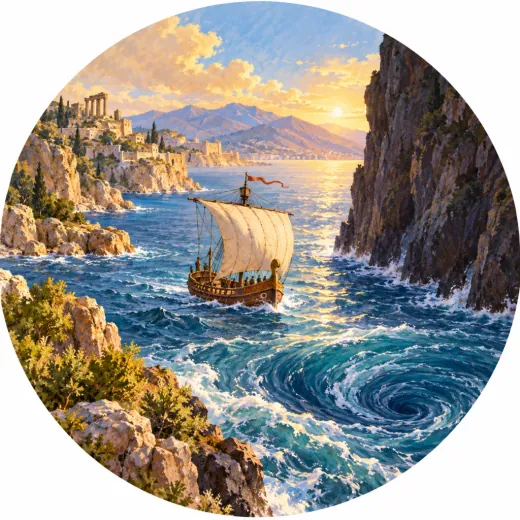
Scylla and Charybdis
“Skylla” and “Charybdis”, in Greek
scary
In the Odyssey, Ulysses has to sail through a very dangerous strait. On one side is Scylla, a monster with six heads on long necks that snatch sailors from their ships; on the other is Charybdis, a whirlpool that swallows the sea three times a day. The sorceress Circe advises him to keep closer to Scylla. The poet Ovid tells that Scylla had once been a beautiful nymph, turned into a monster by a jealous Circe. Tradition places Scylla on the Calabrian cliff and Charybdis on the Sicilian shore.
Did you know? The Italian saying “between Scylla and Charybdis”, meaning between two dangers, comes straight from the Odyssey.
The story
Between the tip of Italy and Sicily there is a stretch of sea so narrow that, on clear days, you can see from one shore to the other. It is called the Strait of Messina. Today ferries cross it, and fishing boats, and ships laden with goods. But three thousand years ago, for a sailor, it was the most dangerous place in the world.
Because, the poets tell us, two monsters lived there.
One was called Scylla. She stood on the high part of a cliff, inside a cave, and she looked like something sailors could not describe without lowering their voices. Twelve legs, all dangling. Six very long necks, coming out of the rock like snakes. And on each neck a head, with three rows of crowded teeth, ready to bite.
The other was called Charybdis. She was on the opposite shore, beneath a wild fig tree. She was a whirlpool. Three times a day she sucked in the sea, swallowing everything around her: water, fish, boats, men. Then, three times a day, she spat it out again, with a roar that could be heard miles away.
To pass between those two was like walking between a blade and an abyss.
And yet there was a man who had to do it. His name was Odysseus.
He had left Troy many years before, with twelve ships and hundreds of men. Only one ship was left to him. All the other companions had died, little by little, by sea, by hunger, by monsters. He wanted only to go home.
Before setting out, the sorceress Circe had given him some cruel advice.
"When you reach the Strait," she had said, "do not try to fight Scylla. It cannot be done. She is immortal. Sail close to her cliff, as fast as you can. You will lose six men. But if you go near Charybdis, you will lose everyone. Better six than all."
Odysseus nodded. He told nobody what he knew. He did not tell his sailors, so as not to frighten them, so as not to make them stop. He put on his armour and took two spears, as if his courage might be enough. He climbed on deck, and looked ahead.
It was dawn. The fog over the sea was low, grey, damp, and the wind was almost still. In the fog a sound could be heard. A distant, continuous rumble, as if the sea were breathing.
They entered the Strait.
The rowers fixed their eyes on Charybdis. She was the one you could see, on the right-hand side: an enormous hole, spinning on itself, and roaring. The water poured in, black and foaming, and for an instant the sand of the seabed lay bare. Some of the men cried out. Everyone rowed harder, and the helmsman steered towards the opposite shore, to move away from the whirlpool.
That was the moment Scylla struck.
They did not see her coming. From the top of the cliff, six heads came down together, quick as arrows, and each one seized a man. Six sailors, the strongest, the nearest to the side, were lifted into the air, hands stretched out, shouting the names of their companions.
Odysseus raised his spear. It was too late.
He himself tells it, years later, and says that it was the saddest scene of his whole long journey: six men struggling in the void, halfway up, above the monster's teeth, calling out his name. Then the cave swallowed them.
The ship went on. Odysseus did not turn round. There was nothing else to do.
But who was Scylla? She was not always a monster.
Ovid, more than seven hundred years after Homer, told another story. A sad one.
Scylla was a nymph. A beautiful young woman, who loved to play on the beach, with her feet in the water, and refused all her suitors. One day a sea god, Glaucus, rose from the waves and fell in love with her. He tried to speak to her, to stop her. But she, frightened by that creature half man and half fish, ran away to the highest rock.
Glaucus, in despair, went to ask Circe, the sorceress, for help, for a love potion.
But Circe, seeing him, fell in love with him. And since Glaucus loved another, her jealousy turned cruel. She did not touch him. She prepared a poison and went to the bay where Scylla bathed every day. She poured the herbs into the water.
When Scylla entered the sea, something moved around her hips. She looked down and saw dogs' heads, snarling, attached to her body. She ran away, but the monsters ran with her. The more she tried to flee, the more those heads clung to her.
She remained so for ever, on her cliff above the sea. Ovid tells us that, full of hatred for Circe, from then on she destroyed the ships of those who passed, until, the poets say, she too turned to rock, and a rock in that Strait still bears her name.
That is why, they say, sailors have always felt a sort of sad respect for that Strait. Because there lived a girl whom nobody had protected.
Even today, in Italy, when you find yourself between two dangers, and do not know which to choose, people use a phrase that comes from those waters: "to be between Scylla and Charybdis".
If one day you cross the Strait, perhaps on a ferry, on a foggy morning, listen carefully. Beneath the noise of the engine there is a distant rumble.
It is the sea, breathing.
Relatives around the world
In the trails
Listen / Read next
- Music to read by: Cinematic JourneyEpic film-style music, no lyrics, by Ciro Simone IrmiciSpotifyYouTube Music
Sources
- Omero, «Odissea», libro XII
- Ovidio, «Metamorfosi», libri XIII e XIV
