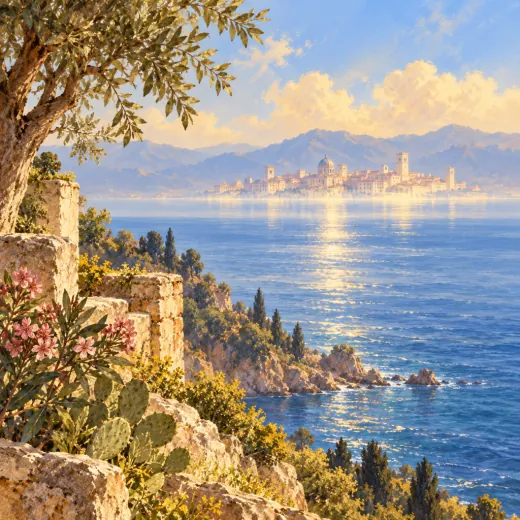
The Fata Morgana
the sorceress of the cities in the sky
not scary at all
Morgana is the sorceress of the King Arthur stories. According to the scholar Arturo Graf, the tales of Arthur reached Sicily with the Normans in the eleventh century, and so her name became linked to the Strait of Messina. In Reggio the visions that sometimes appear on the water are called “Morgana”: castles, towers, arches and pillars that are not there. The first to give the phenomenon this name was the chronicler Marc'Antonio Politi, in 1617. The true part is spectacular: it is a mirage, and you can really see it.
Did you know? “Fata morgana” has become the scientific name of a kind of mirage studied all over the world: when the air above the sea has layers at different temperatures, distant coasts look like floating cities.
The story
When the sea is calm, at dawn, and over the Strait of Messina the air is still as glass, something can happen that nobody forgets.
From the beach at Reggio Calabria, you look towards Sicily. You should see a low coast, a few hills, perhaps a ship. Instead, suddenly, the horizon is transformed. Towers appear. Arches. Very tall columns, like those of a Roman aqueduct. Castles that rise and sink. Trees that seem to walk. The buildings stretch, bend, break and put themselves together again, as if they were made of water.
Then, within a few minutes, everything vanishes.
The people of Reggio have a name for this spectacle. They call it the Fata Morgana.
The name, when you hear it, has something strange about it. Morgana is the sorceress of the legends of King Arthur, the king's half-sister, a mysterious woman with magic powers. The French called her Morgain la Fée, which means Morgana the Fairy. And the word "fata" comes from the Latin fata, which means fate. A fairy is, originally, someone who knows or rules fate.
But what has a Breton sorceress to do with a Calabrian mirage?
The scholars have a theory, which they themselves call fascinating but largely speculative. They say that in the eleventh century the Normans came to Sicily, men of the north, who brought with them the stories of their land, including those about King Arthur. For them, Sicily, with its smoking volcano, must have looked like Avalon, the mysterious island, the "island of apples", where Morgana took the wounded Arthur. The king's tomb would be under Etna.
And if the sorceress lived in those parts, it was she who made those impossible cities appear on the sea.
Over the centuries, the name settled. In 1617, a man from Reggio, Marc'Antonio Politi, wrote a chronicle of his city, and was the first to use "Fata Morgana" for those mirages. A few decades later, in 1646, a great scholar, Athanasius Kircher, reported that at Reggio the spectacle was called simply "Morgana". In other places in Italy it had other names. At Naples it was called janare, which elsewhere in Campania is the name of the witches. At Molfetta, in Puglia, they called it Lavandaja, the washerwoman.
The most beautiful descriptions come to us from a careful observer, a certain Angelucci, who one August morning in the mid-seventeenth century saw from Reggio "pillars, arches like Roman aqueducts, castles, towers and trees". He told of it in a letter, and his description went around Europe.
Then science arrived, and explained what was happening.
The Fata Morgana is a mirage. To form, it needs a special condition: a temperature inversion. Usually the air is warmer below and colder above. On certain days, in the Strait, the opposite happens: above a layer of cold air, resting on the surface of the sea, lies a layer of warmer air. The light, passing through these layers, is bent, as in a lens. A sort of duct is created, in which the rays travel curving. The result is a giant concave mirror, which magnifies vertically everything on the horizon.
The distant coasts, the houses, the boats, are stretched upwards, doubled, multiplied. A low wall becomes a rampart. A row of houses becomes a city with towers. And because the layer of air moves, sways, trembles, the images change all the time, and seem alive.
The Strait of Messina is the perfect place for this phenomenon. It is narrow, and there are coasts visible at various distances on both sides. And it has the right conditions, especially in autumn and winter, after a period of wind, when the air falls still.
For this reason, when scientists all over the world speak of a mirage of this kind, they still say "Fata Morgana". The name of a sorceress from the Arthurian legends has become a scientific term, written in physics textbooks.
And the magic? The magic has not gone. It has only changed. Once people believed that behind those cities there was a fairy. Now we know that behind them there is light. And yet, if you happen to see it, on an autumn morning, at Reggio, in front of the still sea, with silver towers slowly rising from the water, you forget all the explanations.
You stop. You hold your breath.
And you thank the sorceress, whoever she may be.
Relatives around the world
In the trails
Listen / Read next
- Music to read by: Cinematic JourneyEpic film-style music, no lyrics, by Ciro Simone IrmiciSpotifyYouTube Music
