The Serpari of Cocullo
the snake catchers of the feast of Saint Dominic
a little scary
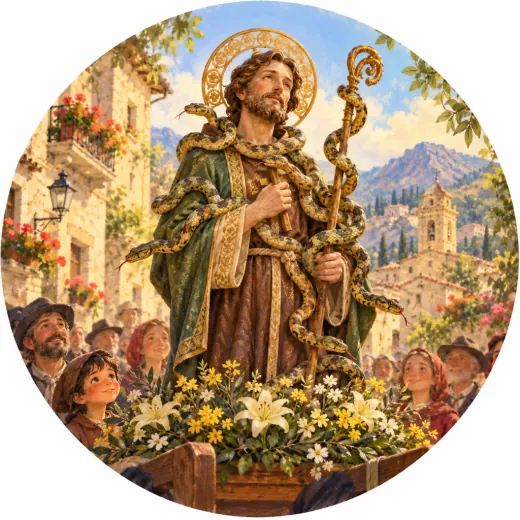
Every 1 May, in Cocullo, the statue of Saint Dominic the abbot goes out in procession completely wrapped in live snakes, which are not venomous. In the weeks before the feast the “serpari” (the snake catchers) catch them in the woods, and after the feast they set them free again. Tradition says the saint, a monk who lived around the year 1000, protected people from snake bites and toothache. Some think the feast continues much older rites of the Marsi, an ancient Italic people famous as snake charmers; many scholars, such as Alfonso Di Nola, give it a Christian origin instead.
Did you know? Cocullo keeps a tooth of Saint Dominic as a relic, and some people pull a little church chain with their teeth to protect them from toothache.
The story
At the end of March, in the mountains of Abruzzo, something happens that looks a little odd from outside. Many men and women, in gloves and boots, walk through the meadows. They look under stones. They push aside the grass. And they search for snakes.
They do not do it from fear, and they do not do it for a living. They do it for Saint Dominic.
The village is called Cocullo. It is small: two hundred and thirteen inhabitants, on top of a hill in the province of L'Aquila, about a hundred and thirty kilometres from Rome. If you look for it on the map, you find it in the middle of nowhere, among woods, narrow roads and mountains. For twelve months of the year it is a quiet place, where the loudest sound is that of the bells.
But on the first of May, Cocullo changes.
Twenty thousand people arrive. Some years, in the past, there have even been fifty thousand. They come from all over Italy, and from the world. Journalists, photographers, anthropologists, the curious. Japanese, German and French television has sent its crews. Even the New York Times has written about it. And the festival is a candidate to become part of UNESCO's Intangible Heritage of Humanity.
What happens on the first of May?
What happens is that the statue of Saint Dominic Abbot, the patron saint of the village, comes out of the church of Santa Maria delle Grazie, at midday. He is a protector saint: he protects against snake bites, toothache and rabies. And on the day of his festival, to honour him, he is covered with live snakes.
Wrapped around the arms, around the shoulders, around the neck of the statue. Snakes that move, that slide, that hiss softly. It looks like a scene from a film. Instead, it is a tradition.
Then the procession begins. It lasts about an hour and a half and goes all around the village, between the houses, through the crowd. People press against the sides, silent, unafraid. When the saint goes back into the church, the snakes are taken off him, and it all ends, around two in the afternoon. In the evening an orchestra plays, and there is a party.
But we must ask: where do they get those snakes?
They are caught by the serpari, the snake catchers. They are about thirty people, men and, in recent years, women too, who know the mountain well. At the beginning of spring, when the reptiles come out of hibernation, they go into the woods and catch them with their bare hands. They put them carefully in wooden boxes, and keep them until the day of the festival.
They are non-venomous snakes. They belong to four species: the cervone, the saettone, the grass snake and the biacco, which is the black snake. They are not venomous, but they remain wild animals, and must be treated with respect.
Today not everything can be done as it once was. The people of Cocullo have a special authorisation from the Ministry of the Environment, which is renewed every two years. Every year they must send a report on the snakes caught. Herpetologists, the experts on reptiles, measure and weigh them. Some are fitted with a tiny microchip, to follow what becomes of them.
And after the festival, all the snakes are taken back to their environment. They return to the woods they came from. With the difference that now a little of Cocullo, in some way, also lives among the stones.
Where does this strange custom come from?
Scholars have answered in different ways. Saint Dominic was a monk, and he is credited with the power to protect from bites. But some think the festival is much older than the saint. They say that in ancient times those mountains were inhabited by a people called the Marsi, famous for knowing how to charm snakes. The Marsi worshipped a goddess, Angitia, linked to reptiles. Every spring, perhaps, they paid her homage. Then the Christians arrived, and the festival changed its name, but not its gestures. It is an old idea, from 1673, but many scholars disagree and give the festival a Christian origin.
Among them is the anthropologist Alfonso di Nola, who wrote about it as early as 1976, in a book on Italian popular cultures. Since then, scholars have never stopped coming.
At Cocullo nobody worries too much about theories. You line up, on a May morning, with your nose in the air, to watch the saint go by covered in snakes. And you think that, deep down, there is something beautiful in a festival where man and snake, for once, are in the same procession.
Relatives around the world
Listen / Read next
- Music to read by: Cinematic JourneyEpic film-style music, no lyrics, by Ciro Simone IrmiciSpotifyYouTube Music
