The Pantafica
Pantafa or Pandafeche, perhaps from “phantasma” · Abruzzo
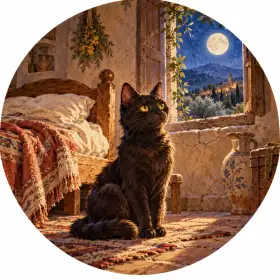
In Abruzzo people say that at night the Pantafica may come: a figure that sits on the chest of a sleeper, heavy as a stone. Whoever wakes up has their eyes open but cannot move or speak. She is described dressed in white, with demonic eyes, covering the sleeper's mouth with her hands. People also said that at night she liked to braid the manes of horses. Today we know what it really is: it is called sleep paralysis, it lasts a few seconds and it is completely harmless.
Did you know? Almost every Italian region has its own “spirit that sits on your chest”: it is the old way of explaining sleep paralysis.
Sources: Gennaro Finamore, «Credenze, usi e costumi abruzzesi» (1890); Sky TG24, «Malanotte, il graphic novel che racconta la leggenda della Pantafa» (2023)
The Werewolf
the man who changes with the full moon · Abruzzo
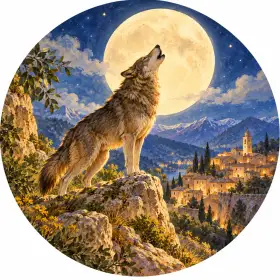
All over Italy, from the Alps to Sicily, people told of the werewolf, the lupo mannaro: a man who on full-moon nights changed shape and roamed the streets howling. It was said that anyone born on Christmas night, or on the Epiphany, would become one, and that to save him his father had to mark a cross under his foot for three Christmases in a row. Against him the surest weapon was silver. Such stories find a home in a land like Abruzzo, where real wolves frightened shepherds for centuries.
Did you know? Today, in the Abruzzo National Park, the Apennine wolf is protected and is one of the park's symbols.
Sources: Antonio De Nino, «Usi e costumi abruzzesi» (1879-1897); Il Giorno, «Istruzioni per licantropi: come si nasce e come si diventa» (2009)
La Bella Addormentata della Majella
the Sleeping Beauty, the nymph Maja · Abruzzo
Maja, the most beautiful of the Pleiades, was the mother of Hermes, son of Zeus. When her son was wounded in battle, she fled with him from Phrygia across the sea and landed at the port of Ortona. She climbed the mountains looking for a herb that could heal him, but snow covered everything and her son died. His body was buried on a peak of the Gran Sasso, which from a distance really looks like a sleeping giant. Maja died of grief on the mountain opposite, which took her name: Majella. From Chieti you can see the profile of a woman lying down.
Did you know? The profile of the “Bella Addormentata” (the Sleeping Beauty) can really be made out when looking at the Majella from the coast on clear days.
Sources: Montagna.tv, «Non solo la Maiella ha la sua bella addormentata»; Italiani.it, «La Majella e il Gran Sasso protagonisti di una famosa leggenda»
The Serpari of Cocullo
the snake catchers of the feast of Saint Dominic · Abruzzo
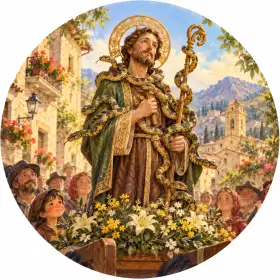
Every 1 May, in Cocullo, the statue of Saint Dominic the abbot goes out in procession completely wrapped in live snakes, which are not venomous. In the weeks before the feast the “serpari” (the snake catchers) catch them in the woods, and after the feast they set them free again. Tradition says the saint, a monk who lived around the year 1000, protected people from snake bites and toothache. Some think the feast continues much older rites of the Marsi, an ancient Italic people famous as snake charmers; many scholars, such as Alfonso Di Nola, give it a Christian origin instead.
Did you know? Cocullo keeps a tooth of Saint Dominic as a relic, and some people pull a little church chain with their teeth to protect them from toothache.
Sources: Il Fatto Quotidiano, «In Abruzzo la festa dei serpari richiama ogni anno 20mila turisti» (2022); RSI, «I serpenti invadono Cocullo»
Ovid the Wizard of Sulmona
“Uiddiu”, in the dialect of Sulmona · Abruzzo
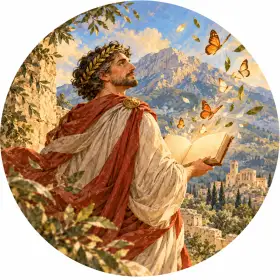
The Latin poet Ovid really was born in Sulmona, in 43 BC, and wrote the “Metamorphoses”, a book full of people turning into trees, animals and stars. For centuries, though, the people of Sulmona did not remember him as a poet: in their tales he had become a very powerful wizard. On the slopes of Mount Morrone there were great ancient ruins everyone called “Ovid's villa”, and it was said the wizard had hidden his treasures there. Those ruins were in fact an ancient sanctuary of Hercules, first Italic and then Roman.
Did you know? Sulmona's coat of arms still bears the letters SMPE, standing for a line by Ovid: “Sulmo mihi patria est”, Sulmona is my homeland.
Sources: Antonio De Nino, «Ovidio nella tradizione popolare di Sulmona» (1886); Ovidio, «Tristia», IV, 10