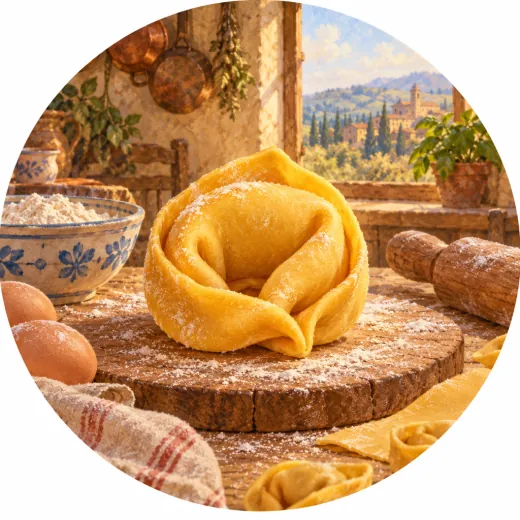
The Legend of the Tortellino
“turtlèin”, in Bolognese
not scary at all
During a war between Bologna and Modena, the legend says, some gods of Olympus stopped for the night at an inn in Castelfranco, exactly halfway between the two cities. The curious innkeeper peeked through the keyhole into the room of the goddess Venus and saw her navel. He was so struck that he ran into the kitchen and copied it in pasta: the tortellino was born. It is a joking story, told by Giuseppe Ceri in a poem that mimics Tassoni's mock-epic “La secchia rapita” (The Stolen Bucket). The filled pasta of those lands, though, really is ancient.
Did you know? Castelfranco Emilia calls itself the “home of the tortellino” and every year celebrates with a festival and a re-enactment of the legend.
The story
The gods of Olympus, as everyone knows, have one big fault: when they travel, they do not book.
A long time ago, in Emilia, two cities were at war. Bologna on one side, Modena on the other. They had been fighting for days, with swords, with lances, with the usual insults. And the most surprising thing is that, every now and then, three divinities came down from Olympus to watch.
There was Mars, the god of war, who never missed one. There was Bacchus, the god of wine, who went wherever there was something to drink. And there was Venus, the goddess of love, who went with them because on her own she was bored.
One evening, after a long day of battle, the three were tired, hungry and covered in dust. They were looking for somewhere to sleep. Nearby there was a village called Castelfranco, exactly halfway between Bologna and Modena, so that neither city could truly say it was theirs. And in that village there was an inn: the Corona.
The innkeeper was a middle-aged man, big and red in the face, and he was missing an eye. That evening he was in the kitchen, washing dishes, when he heard a knock at the door. He opened. Before him stood three travellers who shone, though he could not have said why.
"A room," said the sturdiest. "And food. And drink."
The innkeeper, who never asked his customers questions, put them in the best rooms. He served dinner. Bacchus liked the wine very much, and drank three jugs. Mars ate like a wolf. Venus tasted everything, with a bored air. Then they went to sleep.
The next morning, at dawn, Mars and Bacchus rose early. They had a battle to watch, a toast to make. They paid, or so it seemed, and left into the sun.
Venus, on the other hand, was still asleep.
Around mid-morning, from her room, a sweet and bored voice was heard. "Innkeeper!"
The innkeeper ran up the stairs. He reached the door. It was not properly closed, or perhaps not closed at all. Out of politeness, he stopped. But his eye, or rather his only eye, fell upon the keyhole. He did not want to look. But he looked.
It was a moment. The goddess was stretching on the bed, the covers slipped away. She had just woken, half uncovered, as beautiful as only a goddess can be. And the innkeeper, through the keyhole, saw one thing: her navel.
Small. Round. Perfect.
The innkeeper stood still. He forgot what he had come up for. He forgot to knock. He almost forgot to breathe. Then, with slow steps, as if in a dream, he went down the stairs, returned to the kitchen and sat at the table.
He could think of nothing else.
In front of him there was a heap of flour, some eggs, the rolling pin. It was his job: he made pasta every day. So, almost without noticing, he began to work. He rolled out the dough thin, thin as a veil. He cut it into squares. He put a little filling inside, meat, cheese, a touch of nutmeg. Then he folded it, turned it around his finger, pinched the ends together.
When he opened his hand, on the table there was a little ring of pasta, with a tiny hole in the middle, round and perfect.
It was Venus's navel.
He boiled it in a hot broth. He tasted it. It was the best thing he had ever eaten.
Upstairs, the goddess got up, dressed, and came down the stairs. The innkeeper brought her a steaming plate. Venus ate one, then two, then ten. She found it delicious. She asked what it was. The innkeeper, red with embarrassment, did not dare tell the truth.
"It is a secret of the house," he answered.
Venus smiled and left. And the innkeeper, for the rest of his life, went on making his little masterpiece, which became famous throughout the region, and then throughout Italy. They called it the tortellino.
This is the story told at Castelfranco Emilia, where every year there is a big festival, with a re-enactment, and where the town calls itself "the homeland of the tortellino". It is also told in a joking poem that mimics Alessandro Tassoni's "La secchia rapita" (The Stolen Bucket): it is by Giuseppe Ceri, between the nineteenth and early twentieth century, and speaks of a one-eyed Bolognese innkeeper who learned to make tortellini by imitating the navel of Venus. Bologna and Modena, of course, go on quarrelling over who invented them.
And the truth? Alas, less poetic. The documents say that in 1112 and 1169 someone was already writing of "turtellos". In 1289, in Bologna, some students were arrested in a tavern, on Epiphany day, while eating "tortellos". In the sixteenth century a famous cook, Bartolomeo Scappi, described them as small and made "in the shape of cappelletti", that is, little hats, and not navels.
But it matters little. At the table, in Emilia, the best story always wins.
So, the next time you eat a plate of tortellini in broth, pause a moment. Look at one of those little rings of pasta in your spoon. And thank, with a smile, that one-eyed innkeeper, who found his inspiration through the hole of a keyhole.
Relatives around the world
Listen / Read next
- Music to read by: Cinematic JourneyEpic film-style music, no lyrics, by Ciro Simone IrmiciSpotifyYouTube Music
Sources
- Gambero Rosso, «Le tante vite del tortellino: origini e storia»
- Giuseppe Ceri, «L'ombelico di Venere» (poemetto scherzoso, fine Ottocento)
