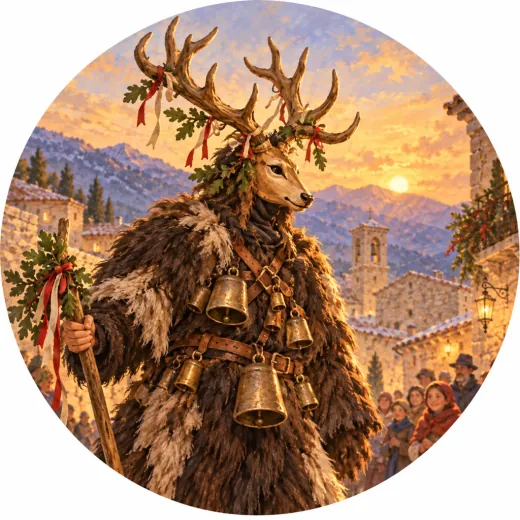
The Uomo Cervo of Castelnuovo al Volturno
the Stag Man, “Gl'Cierv”
scary
On the last Sunday of Carnival, at sunset, the Uomo Cervo (the Stag Man) comes into the square: a man covered in furs, with a mask and a great branching rack of antlers on his head, who runs among the crowd and stirs everyone up. He is the wild force of nature. With him come the Cerva (the Hind) and Martino, a figure dressed in white who tries to catch him. At the end the hunter arrives and the stag falls. But soon after he gets up again: it is nature that dies in winter and is reborn in spring.
Did you know? The association that keeps the rite alive calls it an “ancestral tradition”, with no firm dates: nobody can say exactly how old it is.
The story
At Castelnuovo al Volturno, on the last Sunday of Carnival, the light goes quickly.
The village lies at the foot of the Mainarde mountains, and when the sun sinks behind them the air turns cold at once. In the square a great crowd has gathered: children on their fathers' shoulders, old people in overcoats, young men pushing to see better. They speak in low voices. Nobody says why, but everybody knows it is about to begin.
The square, suddenly, no longer looks like a square. It looks like an open-air theatre, with the dark as its curtain.
Then the shouts arrive.
First from far off, then closer and closer, loud, until the crowd opens as if someone had cut it in two. Out of the smoke and noise he comes.
It is the Uomo Cervo, the Stag Man. Gl'Cierv, they call him here, in the local language. His body is covered in dark skins, his face hidden by an animal mask, and on his head a great rack of antlers, all branching, that sways with every step. He does not walk like a man. He moves in jerks, lowers himself, rears up. For a moment the children stop breathing.
It is not a show that makes you laugh. It is a wild animal that has come in among the people. And winter, at that moment, has his face.
With him there is another figure, almost identical. It is the Doe. She repeats his every gesture, chases him, imitates him, circles him. Together they look like a single animal split in two, and the whole square makes room for them.
So the dance begins. A step, a leap, a challenging look at the crowd. The two deer run among the people and the people draw back, laughing and a little trembling, as you do before something that might not stop.
And now Martino appears.
He is all white, from head to foot, and wears a pointed hat on his head, tall as a candle. Amid all that black of skins and antlers, he looks like a little piece of light. Martino dances too, a dance all his own, as if to bring order to so much disorder. And then he tries to do what nobody has yet dared: to stop the deer. He throws himself among the antlers, stretches out his arms, tries to seize them.
But he does not succeed. The Deer darts away, the Doe follows him, Martino is left with empty hands, and again the crowd draws back.
Then the people enter the scene. They are the inhabitants of Castelnuovo, the same ones who were watching before. They take the ropes. They close in around the animals and tie them up, until the deer, little by little, are forced to bend.
For a moment everything seems over. The wild force has been tamed. The square breathes.
And then, in that silence, a voice is heard.
It is the only voice in the whole ritual. All the other characters shout, dance, pant, but do not speak. She does: she is the Popolana, the peasant woman. She goes up to the tied deer and mocks them. Then she feeds them, gives them food.
And it is precisely that gesture, strange and cruel together, that sets everything off. The deer rebel. They struggle, break free, run again. Fiercer than before.
Nobody laughs any more. Someone grips a child's hand tighter, someone else steps back towards the wall of the houses.
At the far end of the square, now, another figure moves. It is the Hunter. Nobody quite knows who he is, or where he comes from. There is something mysterious about him, something ancient. He does not run. He advances slowly.
He raises his weapon. Today it is a rifle, they say; in far-off times perhaps it was a spear, or a bow with arrows.
The shot echoes among the houses, and the echo bounces all the way to the mountains.
The Deer falls. Then the Doe falls. They lie there, on the paving, motionless. The crowd holds its breath, and the silence, for a few seconds, is louder than any noise.
It seems over. Winter is dead.
The Hunter approaches the two bodies. He bends down. And he blows into their ears. A single breath, light, as if calling someone from far away.
For an instant nothing happens.
Then the Deer moves. He lifts his head, the antlers sway. The Doe does the same. Slowly, as if waking from a long dream, the two rise. They are different, transfigured. The fury and the challenge of before are gone. The chaos has been tamed.
This is the meaning, say those who know the ritual. Winter does not end because someone defeats it: it ends because it dies and then returns, changed, ready to give way to spring. It is the passing of the seasons, nature renewing itself through a death. The Association that keeps the ritual says that it recalls the most ancient meaning of Carnival, an echo of a Dionysian myth, and that it is also men's attempt to keep in check the uncontrolled violence of nature.
The square applauds, and for a moment seems almost sorry to have been afraid.
Then the people disperse, in the cold of the evening, into the narrow streets of the village. Tomorrow will be a day like any other. But for one hour Castelnuovo has reminded itself of something ancient: that even fury has its season, and that after every death, when someone breathes into the right ear, there is always an awakening.
Relatives around the world
Listen / Read next
- Music to read by: Cinematic JourneyEpic film-style music, no lyrics, by Ciro Simone IrmiciSpotifyYouTube Music
Sources
- Alessandro Testa, «Il carnevale dell'uomo-animale. Le dimensioni storiche e socio-culturali di una festa appenninica», Napoli, Loffredo (2014)
- Associazione Il Cervo APS, «Gl'Cierv. La storia»
