The Mamuthones of Mamoiada
Mamuthones and Issohadores
a little scary
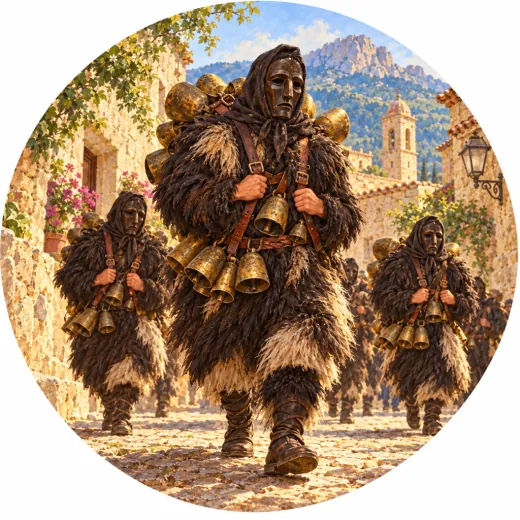
In Mamoiada, in the heart of Barbagia, mysterious figures come out into the street: the Mamuthones. They wear a black wooden mask with a gloomy expression, dark sheepskins and lots of cowbells on their backs. They walk with small, heavy steps, and at a sign from the head Issohadore they all make three quick jumps together to ring the bells, as if they were one big beast. They are accompanied by the Issohadores, with red jackets and white masks, who throw a rope to catch someone in the crowd. Where they really come from, nobody knows.
Did you know? There are twelve Mamuthones and eight Issohadores, and they parade in two lines on 16 and 17 January, for Saint Anthony the Abbot.
The story
On the sixteenth of January, in Mamoiada, in the Barbagia, the cold gets into your bones. The stone streets are grey. The mountains all around are dark. But in every neighbourhood, at a certain point, someone lights a fire.
These are the bonfires of Saint Anthony the Abbot, one for each neighbourhood, and around each one people stop, warm their hands and wait. They say the saint went down to hell and stole fire, to bring light and warmth to a land that was freezing. And in Mamoiada, every year, winter begins to answer in just this way: with fire in the squares.
The next day is the seventeenth. You arrive in the village and feel that something is in the air. Not noise, but waiting.
In one building, the headquarters of the local tourist association, the Pro Loco, someone is getting dressed. In there, men of the village become something else. Whoever puts on the mask, they say, stops being himself. He does not say a word. He does not let himself be recognised.
Outside, people wait. They speak little. The children stay close to the grown-ups and watch the door, a little impatient and a little shy. Someone huddles in a coat, someone holds a hot drink. The smoke from the fires rises straight into the January sky.
Then the door opens.
Before anything else comes the sound. A deep, dull noise, like nothing else: many cowbells, shaken all together. It is not a jingle. It is like a clap of thunder walking on legs.
Then you see them.
They are the Mamuthones. They wear a black wooden mask, carved with hard features, the face of someone who has seen ancient things. On their bodies they wear black sheepskins, which make them look like animals. And on their backs, tied tight, a cluster of cowbells.
They walk in two parallel lines, very slowly. Twelve, usually. They take small, heavy steps, and with each step they sway their shoulders, and the bells answer. At a signal, all together, they jump. The noise rises into your stomach.
None of them speaks. They do not laugh. They do not greet anyone. They do not look at the crowd. They seem like figures arriving from very far away, who do not quite know where they are.
Around them, upright and quick, are the Issohadores. They wear a white mask, a red jacket, a white shirt and white trousers. They are lighter, more agile: they walk at the sides and in front, and in their hands they hold a thin, damp rope made of rush. There are usually eight of them, and unlike the Mamuthones they may speak to the people.
For a moment everything is suspended.
Then one of them looks at you. He swings the rope over his head. He throws it with a whoosh, from a distance of twelve or thirteen metres. If the rope falls on someone, that person is caught. It is a sign of luck, of good omen, for health and for fertility. Almost always they catch a young woman, who laughs, pretends to run away, and then gives in.
The procession moves from fire to fire. Each neighbourhood has lit its own. The Mamuthones circle around them, with that step and that sound, and the flames make the bells glitter. It is the moment many people remember: the black faces, the fire, the noise.
This is "sa prima essida", the first outing of the year for the masks. Afterwards, in the weeks of Carnival, they will come out again.
And you wonder: but what does it mean? Where does all this come from? Who decided it, and when?
Nobody knows for certain. There are no ancient texts that explain it, and the oldest oral accounts of the procession go back to the nineteenth century. Scholars of these rituals have made many guesses.
Some think it is a very ancient rite, perhaps from the Nuragic age. Others say it tells of the victory of the Sardinian shepherds over Saracen raiders: the Mamuthones would be the prisoners, gloomy and bound to their cowbells, and the Issohadores the victors who lead them. Others still see in the rite a ceremony of submission linked to livestock, a totemic rite. Others think of a seasonal rite, perhaps linked to the cults of Dionysus, though the idea is disputed. And many believe that, before it became Christian, it served to drive away evil spirits, with noise and with fear.
Somewhere in the world there are other similar processions, with masks, skins and cowbells, and they have other names: Krampus, Kukeri, Caretos. As if, in different places, people had found the same answer to winter.
When the procession stops, the silence is almost as heavy as the noise. The Mamuthones stand still, heads slightly bowed. Under the mask is a man breathing hard, with the cowbells pulling at his shoulders. You cannot see his face. And perhaps that is right.
If you like, when the day is over, you can go into one of the village cellars and taste a glass of Cannonau. In Mamoiada, in a museum, you can see the masks. Also in Mamoiada there is a tall stone, the stele of Sa Perda Pintà, covered in concentric circles and carved about five thousand years ago. Here, time does not seem like a line. It seems like a circle.
And when you hear, from far away, that dull blow again, that thunder of bells, you understand that the ritual is not over. It never ends. It only waits for the next January.
Relatives around the world
Listen / Read next
- Music to read by: Cinematic JourneyEpic film-style music, no lyrics, by Ciro Simone IrmiciSpotifyYouTube Music
- The words of the dialect: SardinianNonnese, the dictionary of Italian dialects
