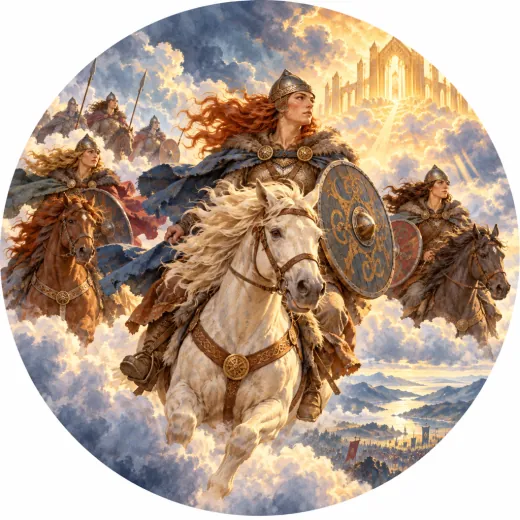
The Valkyries
valkyrjur, “choosers of the slain”
a little scary
The Valkyries are Odin's warrior messengers. They ride through the air over battlefields, wearing helmets and carrying shields, and they choose which fallen warriors deserve to go to Valhalla, the god's great hall. There they welcome them and serve them drinks at the feasts. In the sagas some Valkyries meet human heroes, like Brynhild with the hero Sigurd. Their name means exactly “those who choose the fallen”.
Did you know? The composer Richard Wagner wrote a very famous piece of music, “The Ride of the Valkyries”, which can still be heard in many films.
The story
At dawn, silence returned to the battlefield.
For hours there had been horns, shouts, the drumming of shields like thunder that would never stop. Now the air was still. Only the ravens circled in the sky, and in the wet grass the rising sun lit up helmets thrown on the ground, broken spears, and men lying in a peace from which no one would ever wake them.
A young warrior opened his eyes.
He felt no pain. He felt strangely light, as if someone had lifted a soaking cloak off his shoulders. He looked up at the grey sky and thought of his mother, of the farm, of the dog. Then he heard a sound.
It was a drumming of hooves, in the air. Not the hooves of earthly horses. It came from above, from where the sun rises, and with it came a jingling like a thousand tiny bells.
The young man turned his head.
A woman was riding down from the sky. She wore a gleaming helmet and carried a white shield, and in her right hand a light spear. As her horse galloped, its mane shook dew onto the valleys and hail onto the woods, and wherever she passed the grass bent as if before a wind that was not there. Her face was calm, like the face of someone doing a job she knows well.
She stopped above him and looked at him.
“What is your name?”
The young man told her.
“You fought well,” she said. It was not a compliment. It was a fact, like the colour of the sky. “Come with me.”
“Where?”
“To Odin.”
He felt himself lifted, without knowing how. He found himself on the horse behind her, his arms tight around her shield, while the battlefield grew smaller and smaller below them.
“I was afraid,” he said, after a while. “Before I fell.”
“Everyone is,” the woman answered without turning round. “The ones who say they aren't have never been there.”
There were many Valkyries. The ancients sang some of their names: Guðr, Rota, Skuld, the youngest. Odin sent them to every battle, and it was up to them to decide who should fall and who should win. It was a heavy task. They did it in silence, on horseback, among the clouds. Others bound themselves to the heroes they protected: Sigrún, for example, rode beside a warrior named Helgi and defended him with her radiance.
The young man did not know any of this yet. But he had the whole journey to find out.
Valhalla was a hall so vast that from outside it looked like a mountain. The rafters were spears. The roof was made of golden shields. On the benches, instead of cushions, lay mail shirts. There were five hundred and forty doors, and eight hundred warriors could walk through each one side by side. He tried counting them with his eyes and lost count.
Odin sat at the far end, and at his feet two wolves, Geri and Freki, rested their heads on their paws. The god did not eat: he gave all his meat to the wolves, and for himself he took only wine.
“Welcome,” he said.
On the benches sat warriors of every age, some of whom, the day before, had fought on opposite sides, and now they were passing each other the bread. The young man could not answer. The Valkyrie touched his elbow lightly, and he sat down.
A plate was set before him with the meat of a boar, Sæhrímnir, which was cooked every day and was whole again every evening. A goat, Heiðrún, grazed on the leaves of the tree above the hall, and from her udders flowed so much mead that there was enough for everyone. Waiting at the tables were the Valkyries: Hrist and Mist carried the horn, and others came after them. They laughed beneath their helmets and kept the jugs steady.
“And tomorrow?” the young man asked.
“Tomorrow we fight,” one of them answered. “Out in the yard. Every day. And when evening falls, everyone is healed and sits down at this table.”
“Why?”
“Because one day there will be a real battle,” said the Valkyrie. “And you will all have to be ready.”
He nodded. He did not fully understand. He took the horn and drank.
They say, though, that one of the Valkyries once made a mistake.
Odin had decided that in a war between two kings, the older one, Hjálmgunnar, would win. But the Valkyrie, whose name was Brynhild, had looked into the eyes of the younger one, Agnar, and decided that he was the one who deserved victory. Hjálmgunnar fell. Odin did not shout. It was worse than that: he looked at her for a long time with his single eye, without a word.
He touched her with a sleep-thorn. “You will never choose the fallen again,” he told her. “You will marry, like all the women of the earth.”
“Then I will marry only a man who does not know fear,” she replied.
Odin looked at her a moment longer. Brynhild fell asleep on a mountain, in a hall made of shields, and around her the god lit a wall of fire, so that no one with the slightest trace of fear could get through.
She slept for a long time. Until one day a young hero came riding, and his name was Sigurd. He saw the fire and did not slow down. He rode through it, and behind the flames he found a wall of shields, and behind the shields someone lying down, with a helmet on. Sigurd came closer and gently lifted it off. Underneath was a woman.
She opened her eyes. For a moment she lay gazing at the sky, like someone stepping back into a room after many years. And the first thing she said was a greeting, not to him but to the world:
“Hail, day! Hail, sons of day! Hail, night and daughter of night! Look kindly on us here, and give victory to those who sit.”
Then she looked at Sigurd, and understood that the one she had been waiting for had come.
In Valhalla, that night, the young warrior filled his horn for the third time. Someone at the far end of the hall was telling the story in a low voice, and the Valkyries, for once, were listening.
Relatives around the world
In real history
Listen / Read next
- Music to read by: Cinematic JourneyEpic film-style music, no lyrics, by Ciro Simone IrmiciSpotifyYouTube Music
Sources
- Poetic Edda, Völuspá and the poems of Sigurd
- Snorri Sturluson, Prose Edda
