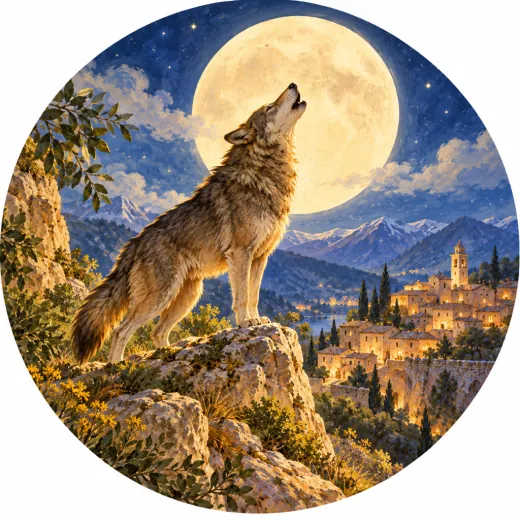
The Werewolf
the man who changes with the full moon
scary
All over Italy, from the Alps to Sicily, people told of the werewolf, the lupo mannaro: a man who on full-moon nights changed shape and roamed the streets howling. It was said that anyone born on Christmas night, or on the Epiphany, would become one, and that to save him his father had to mark a cross under his foot for three Christmases in a row. Against him the surest weapon was silver. Such stories find a home in a land like Abruzzo, where real wolves frightened shepherds for centuries.
Did you know? Today, in the Abruzzo National Park, the Apennine wolf is protected and is one of the park's symbols.
The story
In the mountain villages of Abruzzo, between the Peligna Valley and the Marsica, in winter darkness comes early and lasts long. The houses huddle around the fire. Outside, in the woods, sometimes you hear a long howl, rising and falling, that stops conversations.
The old people, in those moments, lowered their voices and said a name. Lupo mannaro: the werewolf.
A man, in appearance like everyone else, who on full-moon nights turned into a wolf. He wandered through the streets of the village, howling, looking for something. It is a fear that belongs to no single village: it is told all over Italy, from Lunigiana to Campania to Sicily, and far beyond.
How did one become a werewolf?
The answer, in many stories, was only one: you were born that way. Whoever came into the world on Christmas night, around midnight, was destined for that fate. Even whoever was born on the Epiphany, says another study, ran the risk. A birth that should be the most blessed of the year became, instead, a sign.
To ward it off, in some places, fathers did something that today seems cruel. With a red-hot iron they pressed a small cross under the newborn's foot. And they repeated the gesture for the following three Christmases. It was a way, in their minds, of breaking the curse before it came true.
And here is a rule for protecting yourself, one that is still told, though I have not found it written in any source I could read.
If on a full-moon night someone knocked at your door, you must not open at once. You had to stay indoors and wait until the visitor had knocked three times. Why exactly three, nobody explains: it is a rule that was handed down that way.
On moonlit nights, then, families stayed shut in their houses. The children in bed, the candles out, ears pricked. Every knock at the door was counted. One. Two. And then silence. Or three.
Elsewhere, in books, the rules change.
In the Middle Ages, an article tells, there were people who became werewolves by choice, through magic. There were ointments and potions. There were stories of men who took off their skin to put on that of a wolf. And there was even a drink called "lycanthropic water", collected from the footprints left by a werewolf.
To defeat him, the only sure weapon, they said, was silver. A silver blade, or a bullet, sometimes blessed, sometimes made from a crucifix.
And the bite? The one that in films turns anyone into a wolf? It is not part of the oldest tradition. Experts say it is a modern invention, borrowed from vampire stories.
The myth is much older than all this. Some trace it back to the Bronze Age, when nomadic peoples met those who cultivated the land. Gervase of Tilbury, a medieval writer, was perhaps the first to link the transformation to the phases of the moon. And in Anatolia, in very ancient times, women who could not have children invoked the wolf.
Because the wolf, for man, has always been two things at once: a fear and a mystery.
In Abruzzo, then, they knew this well. For centuries real wolves, in the woods and on the pastures, had frightened the shepherds, carrying off sheep and lambs. Stories like the werewolf's find a home in lands like this, where a real animal can give life to a nightmare.
Today that wolf, the Apennine wolf, is protected. It lives in the Abruzzo National Park, and has become one of the symbols of the park.
And perhaps that is right. When you stop being afraid of an animal, you can begin to respect it.
Relatives around the world
Listen / Read next
- Music to read by: Cinematic JourneyEpic film-style music, no lyrics, by Ciro Simone IrmiciSpotifyYouTube Music
