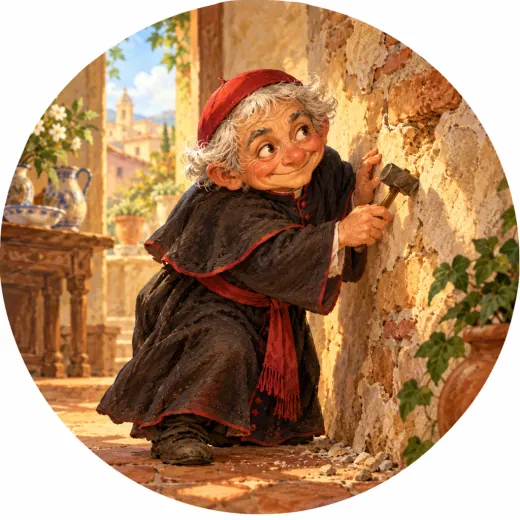
The Mazzamurello
an elf of Roman tradition
a little scary
In Rome, in old houses, when something happened that nobody could explain, people said the Mazzamurello had done it. In papal Rome they pictured him as a little man dressed as a priest, with silver buckles on his shoes and a red skullcap. He can change shape: he can become an old man, a snake or a handsome young man with a hat. He is capricious: with people who treat him badly he plays tricks, with kind people he leaves small mysterious gifts. People say that whoever manages to take the hat off the handsome young man receives gifts in return.
Did you know? In Trastevere there really is a street named after him: the Vicolo dei Mazzamurelli.
The story
If you live in an old house in Rome, one of those with walls as thick as books and stairs that creak, and one evening you hear knock, knock, knock inside the wall, do not be frightened. It is not a mouse. It is not the wind. Perhaps it is him: house sprites, as everyone knows, make noise.
His name is Mazzamurello.
In Trastevere they have known him forever, and there is even an alley that bears his name, near Via di San Gallicano. Narrow, short, with stones that are always damp. They say the Mazzamurelli have lived there forever, among the cats and the washing lines.
Because there are many of them, the Mazzamurelli. They are the capricious spirits of houses. Each one has his own, and lives in it like a tenant who does not pay the rent.
What do they look like? It depends. In the Rome of the popes, when the streets were full of priests in cassocks, they say he appeared as a little dwarf dressed as a cleric. Small, with shoes adorned with silver buckles and on his head a red skullcap, round, like a cardinal's. A priest in miniature, who wandered among the ceiling beams and behind the cupboards.
But he can change. This is his best trick. One day he is an old man, with a crooked white wig. Another day he is a snake, and then it is better not to pass too close. Another day he is a very handsome young man, elegant, who walks down the alley with a hat on his head and a smile that is too wide.
And it is that young man you must be careful with. Because the rule is this.
If you manage to take his hat off, he is forced to give you whatever you like to get it back.
Let us imagine how it might go. One summer evening, a girl of Trastevere is coming home with a basket of washed clothes. She was a modest, kind girl, who greeted everyone and never asked anyone for anything. She walked along the alley, short of breath from the heat.
At the corner she met a young man. He was very handsome, dressed in dark clothes, with a wide-brimmed hat. He looked at her and smiled. "Good evening," he said. "Lovely evening, isn't it?"
The girl said yes, but she felt a shiver. Her grandmothers had taught her to recognise that smile. No young man in Trastevere had teeth that white.
She understood who he was.
She kept walking, calm, without saying a word. The young man followed. He spoke of nonsense: the weather, the stars, a cat he had seen on the roof. She answered, politely. Then, halfway down the alley, while he turned to look at something, the girl raised her arm, quick as a gust of wind, and whisked the hat off his head.
The young man stopped. He put his hands to his hair, which was red and tousled. His smile died, and for a moment he looked like a child caught with his hands in the jam.
"Give it back," he said.
"What will you give me in exchange?" she asked, holding the hat behind her back.
The Mazzamurello snorted. He clenched his fists. Then, reluctantly, he rummaged in his pockets. And things began to come out. A silver coin. Then another. A ring. An old brooch. An embroidered handkerchief. Everything the sprite had stolen and hidden, over decades, in the walls of the city.
The girl gave him back the hat, and he vanished in an instant, laughing and grumbling at once, with a thud like a stone in a well.
The next day, in the basket with her washing, the girl found a little bag. Inside was a gold coin. Nobody knows who put it there.
The story of the Mazzamurelli, on the other hand, really is ancient, and has been told by word of mouth for so long that someone has even used it for tricks. In the sixteenth century a rumour went round that spirits lived in a house in the alley, and people avoided passing close. And they say that in the nineteenth century a dishonest man pretended to be a wizard, and told how he saw devils in his own house, to keep the curious away.
Scholars, when they talk about it, put on a serious face and say these spirits were not born in Rome by chance. They are heirs of a very ancient idea, that of the genius loci, the spirit that protects a place. The ancient Romans thought every house and every street had its own. Over time, that protective spirit became a little mischievous, and each of us has found in the house, along with the guardian angel, a little devil who now and then gets up to something.
So if you have an old house, and at night you hear knocks in the wall, say hello politely. And if one day you meet an elegant young man, with a hat that is too fine and a smile that is too white, pretend nothing is wrong and walk on calmly.
But keep your hand ready.
Relatives around the world
In the trails
Listen / Read next
- Music to read by: Cinematic JourneyEpic film-style music, no lyrics, by Ciro Simone IrmiciSpotifyYouTube Music
- The words of the dialect: RomanNonnese, the dictionary of Italian dialects
