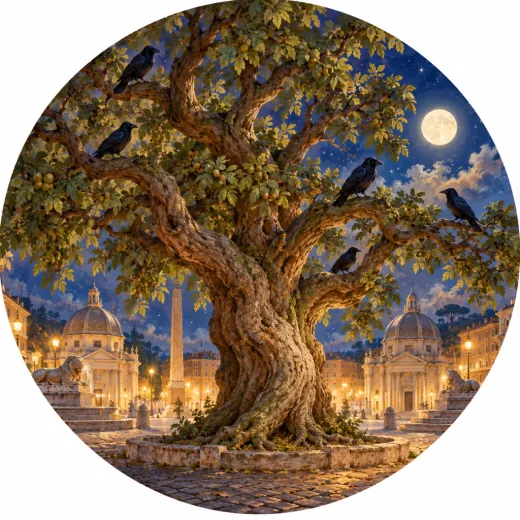
Nero's Ghost and the Walnut Tree of Piazza del Popolo
the chapel built in place of a tree
scary
People said the remains of the emperor Nero were buried at the foot of the Pincian hill, where Piazza del Popolo is today. A great walnut tree had grown over the tomb, and his bones drew spirits and demons that frightened the people living there: Nero could find no peace. In 1099 Pope Paschal II, withdrawn in a cloister, had a vision of the Madonna, who told him to cut down the tree. The pope had it felled and built a chapel in its place. There, almost four centuries later, the basilica of Santa Maria del Popolo was born.
Did you know? Above the high altar of the basilica there is still a relief showing the pope having the walnut tree cut down.
The story
Rome is a city that remembers everything. Even what it would like to forget.
When you walk through Piazza del Popolo now, you see a great open space, with an obelisk in the centre, two twin churches, fountains and benches. But this square has a history that people do not usually stop to think about. And it begins with an emperor.
His name was Nero. He was the last of his family, and he died young, at only thirty, in the year 68 AD. He had been hated by many. The Romans remembered him as a cruel man, who had his mother, his wife and his teachers killed. Some said he had set fire to the city.
At his death, according to the legend, his body was buried in a tomb at the foot of the Pincio hill, right where the square opens today. And over that tomb someone planted a tree. A walnut tree.
Centuries passed. The empire fell. Horses and carts replaced the legions. The tree grew, and grew some more, until it became enormous. Its branches, dark and twisted, covered the tomb like an umbrella.
And, little by little, something happened.
The people living in that area began to hear strange noises in the night. They were not the usual noises of a city. They were whispers, wails, footsteps where nobody was. Whoever passed near the walnut tree, when it was dark, felt a shiver down the spine. Some swore they had seen shadows moving among the branches. Others, that they had heard a voice calling.
The emperor's bones, they said, attracted spirits and demons. The place had become somewhere it was better not to linger after sunset. Women took the long way round to get home. Men did not bring their children to play. The walnut tree was a cursed tree.
It was the year 1099. The inhabitants, tired of being afraid, went to the pope, who was then called Paschal II. They told him everything. They asked him to do something.
The pope listened carefully. Then he withdrew to a cloister, in silence, to pray. He stayed there for a while, alone. And in the silence, says the legend, the Virgin appeared to him.
She spoke with a clear voice. There was nothing to fear, she told him, but there was something to do. He had to do four things.
First: cut down the walnut tree.
Then: dig up and bring to light the bones of Nero.
Then: burn them.
And finally: throw the ashes into the Tiber, so that the river would carry them far away.
Paschal II returned to the city. He gathered the men. He had axes and spades brought. On the appointed day, before a silent crowd, the first axe blows fell on the trunk of the old walnut. The wood creaked, groaned, fell.
They dug beneath the roots. They found the bones. They burned them. And the ash was carried to the river, and thrown into the dark water.
From that day, they say, the spirits vanished. The noises ceased. The night became a night like any other.
Where the walnut tree had stood, a small chapel was built, dedicated to the Virgin. Something simple: a place of prayer, to give thanks and to seal, for ever, what had happened.
Almost four centuries later, in 1472, another pope, Sixtus IV, decided that the chapel was too small. He had it replaced by a great basilica, which took the name of Santa Maria del Popolo, because it stood on the land of the Roman people.
The basilica still exists. Inside are works by great artists, decorated chapels, famous canvases. And above the high altar there is an arch decorated with the legend of the church's founding. If you raise your eyes, you see a small, precise scene: a pope with an axe, felling a tree.
Most tourists pass beneath that arch without looking.
But you, now, know what you are looking at.
Relatives around the world
Listen / Read next
- Music to read by: Cinematic JourneyEpic film-style music, no lyrics, by Ciro Simone IrmiciSpotifyYouTube Music
- The words of the dialect: RomanNonnese, the dictionary of Italian dialects
