The Mazzamurello
an elf of Roman tradition · Lazio
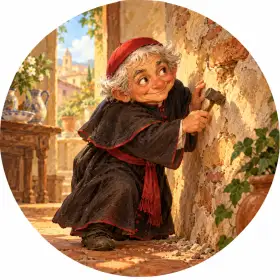
In Rome, in old houses, when something happened that nobody could explain, people said the Mazzamurello had done it. In papal Rome they pictured him as a little man dressed as a priest, with silver buckles on his shoes and a red skullcap. He can change shape: he can become an old man, a snake or a handsome young man with a hat. He is capricious: with people who treat him badly he plays tricks, with kind people he leaves small mysterious gifts. People say that whoever manages to take the hat off the handsome young man receives gifts in return.
Did you know? In Trastevere there really is a street named after him: the Vicolo dei Mazzamurelli.
Sources: Rome and Art, «Il vicolo dei Mazzamurelli»; Regione Umbria, umbriatourism.it, «Cesi, terra di miti e leggende»
Nero's Ghost and the Walnut Tree of Piazza del Popolo
the chapel built in place of a tree · Lazio
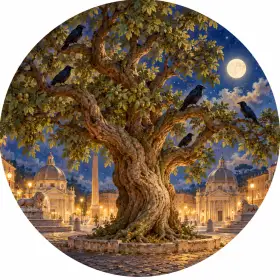
People said the remains of the emperor Nero were buried at the foot of the Pincian hill, where Piazza del Popolo is today. A great walnut tree had grown over the tomb, and his bones drew spirits and demons that frightened the people living there: Nero could find no peace. In 1099 Pope Paschal II, withdrawn in a cloister, had a vision of the Madonna, who told him to cut down the tree. The pope had it felled and built a chapel in its place. There, almost four centuries later, the basilica of Santa Maria del Popolo was born.
Did you know? Above the high altar of the basilica there is still a relief showing the pope having the walnut tree cut down.
Sources: Roma Capitale, Turismo Roma, «I fantasmi di Roma»; ENIT, italia.it, «Basilica di Santa Maria del Popolo»
La Bocca della Verità
the Mouth of Truth, perhaps the face of the god Oceanus · Lazio
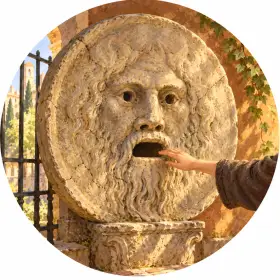
Under the portico of a church in Rome there is the Bocca della Verità (the Mouth of Truth), a big marble disc with a bearded face and an open mouth. The legend says it can tell when someone is lying and expose them. Already in the Middle Ages a guidebook for pilgrims described it as a stone able to tell truth from falsehood. In reality it is an ancient Roman sculpture, perhaps the face of the god Oceanus, and it was probably just a drain cover. It was moved under the portico in 1631.
Did you know? It became famous worldwide thanks to the 1953 film “Roman Holiday”, with Audrey Hepburn and Gregory Peck.
Sources: Anonimo, «Mirabilia Urbis Romae» (XII secolo); Italy Guides, «La Bocca della Verità»
Beatrice Cenci
the girl of Ponte Sant'Angelo · Lazio
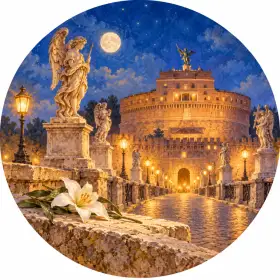
This is first of all a true story. Beatrice Cenci was a young Roman noblewoman of the sixteenth century who, with her family, lived with a violent and overbearing father. She had reported him, but nobody had helped her. On 9 September 1598 the father's body was found at the foot of the Rocca of Petrella Salto: Beatrice and her relatives were accused and tried, and she was sentenced to death. For the Romans she was a victim, and her story became a legend: it is said that every year, on the night between 10 and 11 September, her figure crosses the bridge in front of Castel Sant'Angelo.
Did you know? Her story inspired painters and writers all over Europe, such as the English poet Shelley, who wrote a tragedy about her in 1819.
Sources: Roma Capitale, Turismo Roma, «I fantasmi di Roma»; Percy Bysshe Shelley, «The Cenci» (1819)
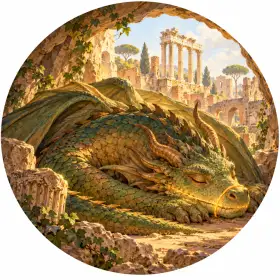
The Dragon of Saint Sylvester
the dragon beneath the Palatine · Lazio
An old legend tells that on the Palatine, in a cave near a stagnant lake, lived a dragon whose poisonous breath made passers-by ill. The priests of the old gods challenged Pope Sylvester: if his God was real, let him stop the monster. Sylvester went down into the cave unarmed, with only a crucifix: the dragon grew tame and the pope tied it up with a thread from his own robe. Then he led it before the Romans, who killed it. Sylvester really was pope, at the time of the emperor Constantine: the dragon is the symbol of a changing world.
Did you know? Saint Sylvester's feast day is 31 December: that is why in Italy New Year's Eve is called “San Silvestro”.
Sources: Iacopo da Varazze, «Legenda Aurea» (XIII secolo), capitolo su San Silvestro; National Gallery di Londra, «Glossario: San Silvestro»