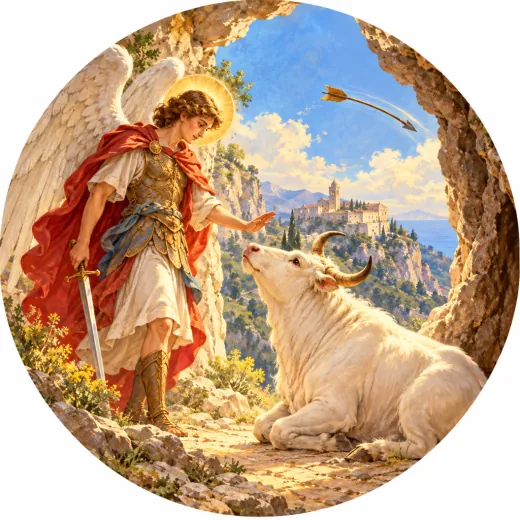
Saint Michael and the Bull of the Gargano
the cave of Monte Sant'Angelo
not scary at all
According to tradition, at the end of the fifth century a rich lord lost the finest bull of his herd and found it in a cave on the Gargano. Angry, he shot an arrow at it, but the arrow turned back and struck him. The bishop of the nearby town ordered three days of prayer, and then the archangel Michael appeared to him in a dream: that cave was his. Since then it has been a church that, it is said, the archangel had already consecrated with his presence. Today the cave is the shrine of Monte Sant'Angelo.
Did you know? The shrine of Monte Sant'Angelo has been a UNESCO World Heritage Site since 2011, together with other places of the Lombards in Italy.
The story
On the Gargano, where the mountain pushes into the sea like the finger of a hand, there once lived a rich man who had a very beautiful bull.
His name was Elvio Emanuele, tradition says, and the bull was the best of his herd. One day, however, it disappeared.
Elvio searched for it through the valleys and the woods. He searched for hours, perhaps days. Around his pastures the white stones shone in the sun, and the sea wind carried the smell of sage and salt. At last, on the mountainside, beneath a rock wall, he found a cave. And inside the cave, in the dark, was his bull.
Elvio was a man used to giving orders. He stopped at the entrance. He could not go in, or he did not want to. The bull stood there, safe and far away, where nobody could touch it. A cold air came out of the cave, smelling of wet earth. Not a sound could be heard, not even a bird. Even the wind seemed to have stopped to watch.
"If you will not come to me," he said, "I shall make you come."
He took his bow. He nocked the arrow. He drew the string back to his ear. And let it fly.
The arrow flew straight. Then, in mid-air, it stopped. It bent as if seized by an invisible hand. And it came back, hissing, and struck him.
Elvio fell. Silence returned to the clearing, and the bull, inside the cave, had not even moved.
When he got up, wounded and frightened, his hand still trembling on the bow, he understood that this cave was no ordinary place. He went down to the town, to Siponto, to find the bishop, Lorenzo Maiorano, and told him everything. The bishop listened without a word. Then he ordered three days of prayer and penance, for him, for the people, for the whole city.
For three days nobody spoke aloud. In the streets of Siponto you heard only footsteps, and the murmur of prayers from open windows. For three days they prayed. It was the year 490.
At the end of the third day, the bishop had a dream. Before him stood the archangel Michael, the chief of all the angels, the one who in the holy books fights the dragon. He told him that the cave was his, and that it must be given to Christian worship. There, he added, where the rock opens wide, the sins of men can be forgiven.
The bishop, however, did not move. On the mountain there were still people who honoured the old gods, and it was not easy to change things in a day.
Two years later, in 492, something far more serious happened. An army arrived from the north: the troops, tradition says, of Odoacer. They besieged Siponto. The walls were high, but food was running low and fear was growing. From the walls you could see the fires of the enemy camp at night, as far as the horizon. The inhabitants gathered around their bishop.
Lorenzo Maiorano asked for a truce of three days, and obtained it. Once again the people spent them in prayer. And once again the Archangel appeared. He promised victory.
At dawn on the fourth day, the people of Siponto went out through the gates. They were not many. They seemed few against so many. But just then, from the sea and from the mountain, a furious wind arose. A storm of sand and hail crashed down on the besiegers. You could no longer see anything. You could not breathe. The grains of ice struck the helmets like stones. The invaders fled, and Siponto was saved.
The bishop, however, had still not entered the cave. He knew it was not for him to do so. So he decided to do what is done when a place becomes holy: he went to Rome, to Pope Gelasius I, to ask permission to consecrate it officially.
The pope approved. The bishop headed back towards the Gargano, full of hope.
It was then, in the year 493, that the Archangel appeared for the third time. And he said something nobody expected: there was no need to consecrate anything. The cave was already consecrated, by his very presence. There was no need for human hands. The bishop had only to build a church in front of the entrance.
And so he did. Stones were carried, walls were raised, and the work went on under the eyes of all the people of Siponto, who for the first time climbed up there without fear. On 29 September 493 the church was dedicated to Saint Michael.
Since then, whoever arrives at the cave of the Gargano finds an inscription, and it reads: "Terrible is this place. Here is the house of God and the gate of heaven."
Terrible, here, does not mean ugly. It means that it makes you tremble a little, that it reminds you how small you are. And it is the right word for a place where a bull, an arrow and an angel changed the life of a mountain.
The centuries passed. From the seventh century the area was part of the Lombard territories, in the Duchy of Benevento. They were a people of warriors, and in Michael, who fights the dragon, they recognised one of their own. His cult spread throughout the Lombard kingdom, until he became the patron of the people.
On 25 June 2011 the sanctuary entered the UNESCO World Heritage list, together with the other Lombard sites in Italy.
But the story, the real story, is always that of a man who only wanted his bull. And who, because of an arrow, stopped to listen.
Relatives around the world
Listen / Read next
- Music to read by: Cinematic JourneyEpic film-style music, no lyrics, by Ciro Simone IrmiciSpotifyYouTube Music
- The words of the dialect: ApulianNonnese, the dictionary of Italian dialects
Sources
- Comune di Monte Sant'Angelo, «Il Santuario di San Michele Arcangelo»
- Iacopo da Varazze, «Legenda Aurea» (XIII secolo), capitolo su San Michele
