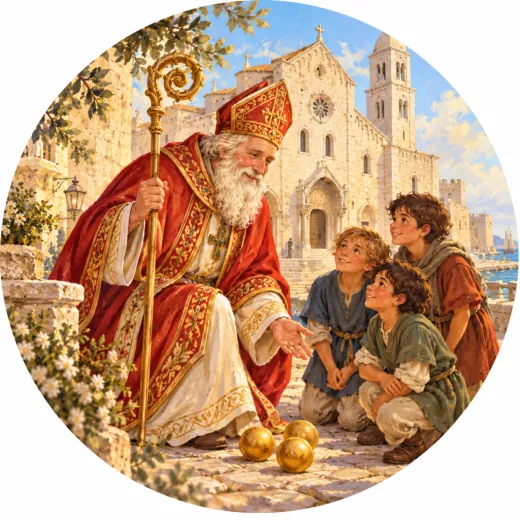
Saint Nicholas and the Three Boys
“Santu Nicola”, in the Bari dialect
a little scary
Nicholas was bishop of Myra, in present-day Turkey, in the fourth century. A medieval legend tells that during a famine a wicked innkeeper made three boys who had stopped at his inn disappear, shutting them in a barrel. The bishop, passing by, discovered everything, prayed, and the three boys came out of the barrel safe and sound. That is why Saint Nicholas is the protector of children. In 1087 some sailors from Bari carried his relics from Myra to their city: this is a historical fact.
Did you know? Another of his legends, the bags of gold secretly given to three poor girls, made him the bringer of gifts: Father Christmas comes from Saint Nicholas.
The story
The first time Nicholas understood what it really meant to be hungry, he already had white hair.
He was bishop of Myra, a city by the sea, in Asia Minor, where Turkey is now. He was a gentle man, but not a weak one. It was said that with a word he could calm storms and with a look stop an unjust judge. But no word, no look, could make the wheat grow.
That year nothing grew in the fields. Famine came. Mothers counted slices of bread, fathers sold their oxen, and in the streets children cried softly, so as not to waste their strength.
Three stories are told about Nicholas, and the first begins in those years of hunger. One is sweet. One is frightening. One ends with a journey.
Let us begin with the sweet one.
There was a man in the city who had once had a great deal and now had nothing. He had three young daughters, beautiful, of an age to marry. But in those days, to marry, a girl needed a dowry, and he did not have a single coin. He spent sleepless nights thinking about his fate: without a dowry, his daughters would be left alone, and who knew where they would end up.
Nicholas heard of it. He did not go and knock on the door. A poor person is proud, and does not always want their poverty to be seen.
One night, while the man slept, the bishop approached the house, stretched his arm in through the window and let fall a bag of gold. Then he vanished into the dark.
The next morning, the man found the gold. He could not believe his eyes. With that money he married off his eldest daughter.
When the second daughter reached the right age, the same bag of gold fell through the window one night. And for the third there was another bag. But that time the man was not asleep. He was waiting. When he heard a step outside, he ran to the window, seized the bishop by his cloak, and recognised him.
Nicholas looked at him gently. "Do not thank me," he said. "Thank God." And he asked him not to tell anyone.
That is why, in the old paintings, at the saint's feet there are three golden balls. And that is why, they say, even today on the night between the fifth and sixth of December children wait for a saint who brings gifts. From Saint Nicholas, over the centuries, came the Santa Claus we know.
But there is the frightening story.
During the famine, three boys were travelling from far away. They were tired, hungry, sweaty. They came to an inn on the road and asked for a bed for the night.
The innkeeper welcomed them with a smile that was too wide. He said there was room, that there was food. The boys ate and went to sleep. They did not know that in that inn, in those months, hunger had driven even men mad.
That night, the innkeeper killed them. In the cellar there was a big barrel, full of salt. He hid the bodies in it, one on top of another, and shut the lid. Then he went back to sleep, as if nothing had happened.
A few days later, Nicholas passed by.
He was travelling to visit the places struck by hunger, and he asked for hospitality in that very inn. The innkeeper served him kindly. The bishop sat down at the table, ate little, and listened.
Something was wrong. There was a wrong kind of silence in that house. Nicholas, who was a saint, and therefore saw with an extra eye, raised his head and said softly: "Bring me the meat you have in the cellar."
The innkeeper turned pale. He stammered. Then he understood that he had been found out, and fell to his knees.
Nicholas went down into the cellar. He stopped in front of the barrel, and for a long moment no sound could be heard. Then the bishop joined his hands and prayed.
They say the lid lifted by itself. And from the barrel, one after another, rose three heads, three pairs of shoulders, three living boys, who looked around as if they had just woken up. They forgot everything. For them only one night had passed.
The innkeeper, faced with the miracle, wept and begged forgiveness. Nicholas forgave him.
That is why Saint Nicholas has been, for centuries, the protector of children and travellers.
There remains the third story, the one about the journey.
Nicholas died in Myra, and was buried there. Seven centuries passed. Then, in 1087, the city was in the hands of others, and his bones were in danger of being lost. In the harbour of Bari there was a group of brave sailors, who set sail for the East with a single purpose: to bring the saint home.
They reached Myra. They entered the church, perhaps with a pretext, perhaps with weapons, and carried off the bishop's relics. They returned to Bari in the spring. An enormous crowd was waiting for them on the quay.
They built a basilica for him, and the basilica is still there, by the sea, with its pale stones. Every year, in May, the people of Bari carry the saint in procession on the water, on a boat covered in flowers.
And every sixth of December, somewhere in the world, a child wakes up and finds a surprise.
It is the bishop of Myra, who has never stopped leaving bags of gold at windows.
Listen / Read next
- Music to read by: Cinematic JourneyEpic film-style music, no lyrics, by Ciro Simone IrmiciSpotifyYouTube Music
- The words of the dialect: ApulianNonnese, the dictionary of Italian dialects
Sources
- Iacopo da Varazze, «Legenda Aurea» (XIII secolo), capitolo su San Nicola
- Catalogo generale dei Beni Culturali, «San Nicola resuscita tre fanciulli»
