'O Munaciello
“the little monk”, in Neapolitan · Campania
In the alleys of Naples people tell of a little man dressed as a monk, with a hood and silver buckles on his shoes. He gets into houses without being seen: sometimes he leaves hidden coins, sometimes he makes things disappear or plays tricks. Whoever sees him must not tell anyone, or the luck goes away. According to the version collected by Matilde Serao, he was a fifteenth-century boy whose mother always dressed him in a habit. According to another, he was the “pozzaro”, the man who cleaned the wells and moved from one house to another underground.
Did you know? In many Neapolitan homes, when something goes missing, people still say “it was 'o munaciello”.
Sources: Matilde Serao, «Leggende napoletane» (1881); Fanpage.it, «La leggenda del Munaciello, storia del piccolo monaco»
La Bella 'Mbriana
perhaps from “meridiana”, the midday light · Campania
She is the good spirit of the house: a beautiful lady who appears for a moment, usually near the window in the hot hours of the afternoon, or as a gecko on the wall. She brings peace and luck to the family, but she is touchy: that is why people greet her when coming home and never say out loud that they want to move house. In some homes a chair is left free for her. A legend says she was a lost princess, and the king asked everyone to welcome her kindly.
Did you know? In Naples you never chase away a gecko in the house: it might be her.
Sources: Napolike, «La Bella 'Mbriana: lo spirito protettore delle case napoletane»; Giuseppe Pitrè, «Curiosità popolari tradizionali», voll. 7-9, Palermo, L. Pedone Lauriel (1890)
The Janare of Benevento
“janara”, perhaps from Diana, the goddess of the night · Campania
The janare were the witches of Benevento: ordinary women by day, at night they rubbed themselves with an ointment and flew away. People said they gathered under a huge walnut tree by the river Sabato, and that they got into houses by slipping under the doors like a breath of wind. To keep them out, a broom behind the door was enough: the janara had to count all its bristles, and meanwhile dawn arrived. A saint, the story says, had the walnut tree cut down, but the tree always grew back in the same place.
Did you know? In the seventeenth century a doctor from Benevento, Pietro Piperno, wrote a whole book about the witches' walnut tree, trying to explain it as superstition.
Sources: Pietro Piperno, «De Nuce Maga Beneventana» (Seicento); Smithsonian Magazine, «How this Italian town came to be known as the city of witches»
The Siren Parthenope
“Parthenope”, maiden, in Greek · Campania
Parthenope was one of the Sirens of Greek myth, who lured sailors with their song. When Ulysses sailed past them without being enchanted, tied to the ship's mast, in one version Parthenope was so desperate that she threw herself into the sea. The waves carried her body to a small island in the gulf, Megaride, where tradition says Castel dell'Ovo stands today. Greek sailors buried her, and a Greek city named after her was born there. Matilde Serao tells another version, in which Parthenope is a Greek girl who ran away for love.
Did you know? The oldest Sirens were bird-women: those with fish tails are a medieval idea.
Sources: Licofrone, «Alessandra»; Matilde Serao, «Leggende napoletane» (1881); Omero, «Odissea», libro XII
The Cumaean Sibyl
the prophetess of Cumae · Campania
At Cumae, on the coast near Naples, lived the Sibyl, the prophetess of Apollo. The poet Virgil tells that the hero Aeneas went to her for help: the Sibyl foretold his future and guided him into the world of the dead, by way of nearby Lake Avernus. She was said to write her prophecies on palm leaves, which the wind then scattered. Another story tells that the god had given her a thousand years of life, but not youth: so she became tiny and terribly old.
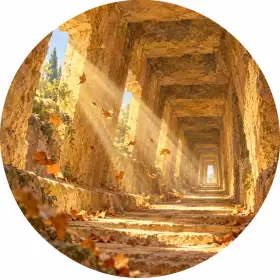
Did you know? At Cumae there is a long corridor carved in the tufa that the archaeologist Amedeo Maiuri named the “Sibyl's Cave” in 1932; today many scholars think it was a military tunnel.
Sources: Virgilio, «Eneide», libro VI; Ovidio, «Metamorfosi», libro XIV; Parco Archeologico dei Campi Flegrei, «Cuma»