The Kingdom of the Fanes
“Rëgn de Fanes”, in Ladin · Trentino-South Tyrol
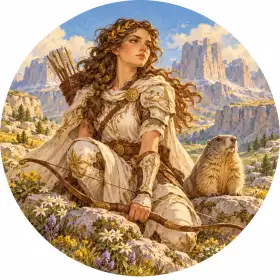
This is the great saga of the Ladin people of the Dolomites. On the Fanes plateau lived a people allied with the marmots, until the foreign king the queen had married changed the kingdom's emblem, removing the marmot and putting an eagle in its place. That betrayal was the beginning of the end. The saga features the warrior princess Dolasilla, with white armour and arrows that never miss, an evil wizard and a hero called Ey de Net. In the end the few surviving Fanes took refuge inside the mountain, where they are still waiting for the sound of the silver trumpets.
Did you know? The saga was collected and partly stitched together by the writer Karl Felix Wolff, who joined fragmentary, scattered oral material.
Sources: Karl Felix Wolff, «Dolomitensagen» (1913) e «Il regno dei Fanes» (1932); Associazione turistica Alta Badia, «Miti e leggende ladine»
King Laurin and the Rose Garden
“Rosengarten”, rose garden, in German · Trentino-South Tyrol
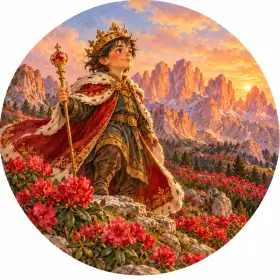
Laurin was the king of the dwarfs and guarded treasures inside the mountain. He had a belt that gave him the strength of twelve men and a cloak that made him invisible, and on the rock he grew a garden of roses. He fell in love with a princess and carried her off, but the knights who came to free her found him by following the roses. As a prisoner, Laurin cursed the garden: nobody would ever see it again, by day or by night. But he forgot about dawn and dusk.
Did you know? That is why the Dolomites turn pink at sunrise and sunset: in Ladin this phenomenon is called “enrosadira”.
Sources: Trentino Marketing, visittrentino.info, «Il giardino di rose di re Laurino»; Poema tedesco «Laurin» (XIII secolo)
The Salvanèl
from the Latin “silvanus”, the one of the woods · Trentino-South Tyrol
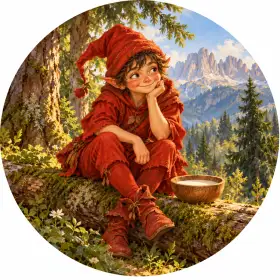
The Salvanèl is a small, quick elf dressed in red from head to toe who lives in the woods of Trentino. He loves pranks: he makes walkers lose the path and at night he sneaks into the stables to drink the milk. But he is also a guardian: he punishes anyone who picks flowers, cuts trees for no reason or lights fires carelessly. He has a big relative, the Salvan, the bearded wild man dressed in furs, who knows all the secrets of the mountain.
Did you know? In a Ladin tale from the Fassa valley a salvanèl comes out of a snuff box and offers a travelling pedlar to grant a wish, but the frightened man closes the box again and throws it into a crack in the rocks.
Sources: Trentino Marketing, visittrentino.info, «Le misteriose creature dei boschi: Salvan, Vivane, Bregostane»
The Anguane
called Vivane in the Fassa valley · Trentino-South Tyrol
The Anguane live near water: springs, streams, lakes and damp caves. They helped people who got lost in the mountains and sometimes did work for the farmers; in return, people left food on the windowsill. In a tale from the Fassa valley, in a year of poor harvest, a girl offered her services to a farmer of Soraga and asked to sweep the cellar with the only bundle of barley ears; he, wary, gave her fir branches, and she vanished after a magic formula, leaving the cellar full of fir needles instead of barley grains. Their name changes from valley to valley: Aquane, Anguane, Vivane.
Did you know? In the Fassa valley the little openings in the shutters of old houses are still called “Vivane windows”: food was left there for them.
Sources: Trentino Marketing, visittrentino.info, «Salvan, Vivane, Bregostane»; MUSE, Museo delle Scienze di Trento, contributo di Camuri su incisioni rupestri e Anguane
The Salighe
“Salige Fräulein”, the blessed maidens · Trentino-South Tyrol
The Salighe are kind fairies of the Tyrolean mountains, dressed in white. They live under rocks and glaciers and protect the chamois and other wild animals. In one tale they nurse a fallen young hunter for three days in a crystal palace, but make him promise not to hunt chamois, alpine hares and white ptarmigans and not to show anyone the way. When he breaks his promise one winter and chases a chamois, the three fairies appear in white robes, there is a flash of lightning and the boy falls.
Did you know? Their name comes from the old German “sælic”, which means blessed, happy.
Sources: Ignaz Vinzenz Zingerle, «Sagen aus Tirol» (1891); Südtirolerland, «Saghe e leggende»