The Agane
“lis Aganis”, in Friulian · Friuli-Venezia Giulia
The Agane are mysterious women of the streams and caves of Friuli: their name, some say, comes from the popular Latin “aquana”, a water nymph. They always look like women, sometimes young and beautiful, sometimes old, and they dwell in springs, brooks and rivers. The story goes that on full-moon nights they put on white robes, dance and hang their clothes to dry in the moonlight. One of the places linked to their appearances is the Macilla stream, near Chiusaforte.
Did you know? The eco-museum of the Friulian Dolomites is called “Lis Aganis”, in honour of these creatures.
Sources: Regione Friuli Venezia Giulia, Catasto grotte, «Bus de le Anguane»; Il Nordest, «Bosco che vai, folletto che trovi»
The Benandanti
“benandants”, those who go for good · Friuli-Venezia Giulia
In the sixteenth and seventeenth centuries some Friulian peasants told an astonishing story: four nights a year, while their bodies slept, their spirits went out to fight against witches. They were armed with fennel stalks, the witches with sorghum canes. If the benandanti won, the harvest would be good; if the witches won, hunger would come. They were the ones “born with the caul”. We know about them because the Inquisition questioned them, and the records have come down to us.
Did you know? The historian Carlo Ginzburg told their story in the book “The Night Battles” (1966), studied all over the world.
Sources: Carlo Ginzburg, «I benandanti. Stregoneria e culti agrari tra Cinquecento e Seicento», Einaudi (1966); Giovanni Pizza, AM, Rivista della Società italiana di antropologia medica (2000)
The Orcolat
“orcolat”, big ogre in Friulian · Friuli-Venezia Giulia
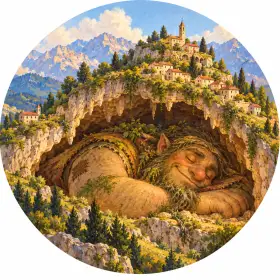
In Friulian “Orcolat” means ogre, a monstrous being, and folk tradition sees him as the cause of earthquakes. Some tales say he sleeps beneath the mountains: as long as he stays calm all is well, but when he turns over in his sleep or gets angry, the earth shakes. It is how the people of Friuli gave a face to the earthquake. When on 6 May 1976, at nine in the evening, a quake of magnitude 6.4 to 6.5, lasting almost a minute, struck Friuli, everyone called it “the Orcolat”.
Did you know? The 1976 earthquake killed almost a thousand people and damaged more than a hundred villages in the provinces of Udine and Pordenone; in Gemona alone 400 people died.
Sources: L'Adige, «Terremoti, l'anniversario dell'Orcolat che sconvolse il Friuli»; Missionari Saveriani di Udine, «La leggenda dell'Orcolat»
The Krivapete
“crooked feet”, in the Slovene dialect of the valleys · Friuli-Venezia Giulia
In the Natisone valleys, where a Slovene dialect is spoken, lived the Krivapete: wild women with crooked feet, the mark that set them apart and gave them their name. On full-moon nights, it is said, they danced in the clearings. They lived in caves near springs, knew all about herbs and could tell when rain was coming. In Vernasso people say the villagers once caught a young one: in exchange for her freedom she taught them to make cheese, bread and baskets. Only sweets, the story says, she did not teach them.
Did you know? Mount Matajur, the mountain of the Krivapete, is also called “the great grandmother” in the dialect of the valleys.
Sources: Aldina De Stefano, «Le Krivapete delle Valli del Natisone. Un'altra storia» (2003); Luciana Percovich e Aldina De Stefano, Preistoria in Italia (2022)
Attila and the Colle del Castello of Udine
the Castle Hill, made with helmets · Friuli-Venezia Giulia
In 452 Attila, king of the Huns, besieged and destroyed Aquileia. The legend says he wanted to watch the city burn from afar: he ordered his soldiers to build a hill, and each of them carried earth in his own helmet. Today Udine Castle stands on that hill, the Colle del Castello (the Castle Hill). For centuries it seemed just a tale, but in 2022 some geologists discovered that the hill really is artificial, made by people. Only it was not the Huns who made it: it was built about 3,000 years ago, in the Bronze Age.
Did you know? With more than 400,000 cubic metres of earth, the hill of Udine may be the largest prehistoric artificial hill in Europe.
Sources: Ministero della Cultura, «Udine, il colle del Castello tumulo artificiale della protostoria europea» (2022); Università di Padova, Dipartimento di Geoscienze, «La collina del Castello di Udine non è naturale» (2022)